Party Games for Small Groups: 10 Games for 3 to 8 Players
Most party games quietly assume ten people. With four of you round a coffee table, teams are lopsided and turns come round too fast. These games are at their best when the group is small.
The short answer
For three to eight players, choose games where everyone plays every round. Two-Word Clues works in pairs, Guess the Rule and Twenty Questions need only four people, and Story Remix, Odd One Out and Conversation Ladder are better in a small group than a large one. A full evening needs four games.
The games we recommend
Help your team guess a secret word by giving clues that are exactly two words long — no more, no fewer.
Why it fits: With four players it becomes two pairs, and the tension of guessing your own partner's clue is sharper than in a big team.
- 4–16 players
- 15–30 min
- No materials
- Seated
- Works seated
Work out a secret person, place or thing by asking no more than twenty yes-or-no questions.
Why it fits: It works with two people and is at its best with three to six, when every guesser gets several questions.
- 2–10 players
- 10–25 min
- No materials
- Seated
- Works seated
One player questions the group and tries to discover the secret rule that everyone else is following when they answer.
Why it fits: In a small circle the detective can track every answer, so the deduction is fair and the reveal lands better.
- 4–12 players
- 15–30 min
- No materials
- Seated
- Works seated
Retell a simple, everyday story in a surprising style — as a weather forecast, a sports commentary, a bedtime story — and let the group guess the style.
Why it fits: Everyone gets a turn inside twenty minutes, and a small audience is far less intimidating to perform for.
- 3–10 players
- 15–30 min
- No materials
- Seated
- Works seated
Hear four things, decide which one does not belong, and convince the table that your reason is the best one.
Why it fits: With four or five players, every argument is heard and nobody waits long to make their case.
- 3–12 players
- 10–25 min
- No materials
- Seated
- Works seated
Keep a chain of connected words moving round the circle — say the first word the last one brings to mind, and be ready to explain the link.
Why it fits: A two-minute warm-up that gets a small group talking fast before the main game.
- 3–12 players
- 5–20 min
- No materials
- Seated
- Works seated
Describe a simple picture using words alone so that a partner, who cannot see it, can draw it as accurately as possible.
Why it fits: It is played in pairs, so even two people can play — and with four you can compare drawings.
- 2–16 players
- 10–25 min
- Paper and pen
- Seated
- Works seated
Build one story as a group, a sentence at a time, with every sentence accepting what came before and adding something new.
Why it fits: A small group can hold one story together, where a large one loses the thread.
- 3–10 players
- 10–20 min
- No materials
- Seated
- Works seated
Climb a three-step ladder of questions on one theme — from an easy opener to a more thoughtful one — so that a table of guests ends up in a real conversation.
Why it fits: Small groups have time for everyone to answer every rung properly.
- 3–10 players
- 15–30 min
- No materials
- Seated
- Works seated
Slip your secret word into ordinary conversation without being caught — and catch other players slipping in theirs.
Why it fits: Around one small table everyone hears every sentence, which makes hiding a word much harder and much funnier.
- 4–12 players
- 20–60 min
- No materials
- Seated
- Works seated
Compare the games at a glance
| Game | Players | Play time | Prep | Materials | Movement | Seated option | Energy |
|---|---|---|---|---|---|---|---|
| Two-Word Clues | 4–16 | 15–30 min | 2 min prep | No materials | Seated | Yes | Lively |
| Twenty Questions | 2–10 | 10–25 min | No prep | No materials | Seated | Yes | Calm |
| Guess the Rule | 4–12 | 15–30 min | No prep | No materials | Seated | Yes | Calm |
| Story Remix | 3–10 | 15–30 min | 1 min prep | No materials | Seated | Yes | Lively |
| Odd One Out | 3–12 | 10–25 min | No prep | No materials | Seated | Yes | Calm |
| Word Association | 3–12 | 5–20 min | No prep | No materials | Seated | Yes | Lively |
| Describe and Draw | 2–16 | 10–25 min | 5 min prep | Paper and pen | Seated | Yes | Calm |
| Yes-And Story | 3–10 | 10–20 min | No prep | No materials | Seated | Yes | Calm |
| Conversation Ladder | 3–10 | 15–30 min | No prep | No materials | Seated | Yes | Calm |
| Secret Word Detective | 4–12 | 20–60 min | 3 min prep | No materials | Seated | Yes | Calm |
Times are editorial estimates, not test results.
A small-group game night, start to finish
Written for four to eight friends and about ninety minutes of play. With only four players, treat every team game as two pairs.
- Step 1 · 8 minutes
Word Association
Warm-up, no scoring. Three or four chains.
- Step 2 · 25 minutes
Two-Word Clues
Two teams or two pairs; one full rotation of clue-givers.
- Step 3 · 20 minutes
Guess the Rule
A gesture rule first, then a spoken one.
- Step 4 · 20 minutes
Story Remix
The finale. Base story — making a cup of tea.
- Step 5 · 10 minutes
Twenty Questions
Optional wind-down while people get ready to leave.
About 83 minutes in total. Times are editorial estimates, not test results.
How we chose these small-group games
A small group is not a large group with people missing. It has its own strengths — everyone can hear, nobody waits long, the conversation never fragments — and its own problems. We chose games against these criteria:
- They truly work with four. Many games list “3+” on the box and are miserable with three. Each pick here has been checked against its minimum, and the rules pages state both a minimum and a practical maximum.
- No one sits out. Elimination games leave a small group with two players and two spectators. Where a game has elimination, we recommend the non-elimination scoring.
- Teams can be pairs. Team games must still make sense when a “team” is two people.
- They last. A small group gets through rounds quickly, so each game needs enough depth to fill twenty minutes without repeating itself.
What changes when the group is small
Turns come round fast. In a circle of four, you speak every fourth turn. That is wonderful for engagement and exhausting in rapid games. Give Word Association and Categories short bursts — five to eight minutes — and then move on.
Everyone hears everything. Whispered prompts are risky when the “other team” is sitting half a metre away. Use host mode on a phone and pass it to the clue-giver.
Silences are louder. Ten people absorb a quiet moment; four people feel it. Choose games with a built-in rhythm, such as question-and-answer or turn-taking, over open “anyone can speak” formats until the group has warmed up.
One person’s mood matters more. If one of four is not enjoying a game, a quarter of the room is unhappy. Offer a choice between two games, and change after one round if something is not working.
Games by exact group size
| Players | Best picks | How to adapt |
|---|---|---|
| 2 | Twenty Questions, Describe and Draw | Take turns as answerer or describer; no scoring needed |
| 3 | Twenty Questions, Odd One Out, Yes-And Story | Avoid team games; rotate the reader or answerer |
| 4 | Two-Word Clues, Guess the Rule, Story Remix | Play team games as two pairs |
| 5–6 | Everything on this page | Teams of two or three; the ideal size for Odd One Out |
| 7–8 | Two-Word Clues, Secret Word Detective, Charades | Two teams of three or four; see also indoor party games |
With exactly three players, team games do not work. Play “all against the clock” instead: in Two-Word Clues, one person gives clues and the other two guess together, and the trio tries to beat its own score next round.
Small-group games for couples, housemates and old friends
A small group usually knows each other well, and that opens up variations that would fall flat among strangers.
- In Guess the Rule, try the rule “answer as if you were the person on your left”. It only works when people can imitate each other affectionately.
- In Two Truths and a Lie, close friends have heard most of the stories. Use the “Two Truths and a Wish” variation, or restrict statements to things that happened this year.
- In Conversation Ladder, a group of four has time for real answers on the third rung. Let them run long.
When the small group is two couples or a set of new neighbours — people who are friendly but not close — begin with Would You Rather and the first group of our icebreaker questions, then move to Two-Word Clues once everyone is relaxed.
Common mistakes with small groups
- Choosing a big-group game and hoping. Shared Connections with four people is just a conversation.
- Keeping elimination rules. Use points instead, so that all four of you are still playing at the end.
- Fixed teams all night. Swap partners between games so that every pairing happens.
- Playing too long. Small groups tire more quickly because nobody gets a rest. Take a break after the second game.
- Skipping the warm-up. Eight minutes of something silly makes the main game twice as good.
Quick answers
What are the best party games for a small group of adults?
Two-Word Clues, Guess the Rule, Story Remix, Odd One Out and Twenty Questions are the strongest games for three to eight adults. Each keeps every player involved in every round, needs no equipment beyond one phone, and can fill twenty minutes without repeating.
What party games can you play with only four people?
With four, play Two-Word Clues as two pairs, Guess the Rule with one detective and three answerers, Story Remix with everyone taking a turn, and Describe and Draw in two pairs. All four games are seated and need nothing more than paper and a pen.
Are there party games for three people?
Yes. Twenty Questions, Odd One Out, Yes-And Story, One-Word Story and Conversation Ladder all work with three. Avoid team games; where a game needs a reader or answerer, rotate the role each round so that everyone does it.
How long should a small-group game night be?
About ninety minutes of play across four or five games, with a break after the second. Small groups move through rounds faster than large ones, and because nobody sits out, people tire sooner than hosts expect.
Prompts and printables for this occasion
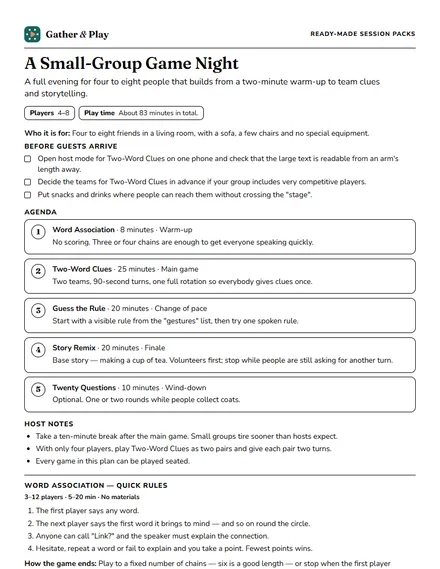
A Small-Group Game Night
A full evening for four to eight people that builds from a two-minute warm-up to team clues and storytelling.