How to Play Describe and Draw
Describe a simple picture using words alone so that a partner, who cannot see it, can draw it as accurately as possible.
- 2–16 players
- 10–25 min
- Paper and pen
- Calm
Quick rules
- Pair up. One person describes, the other draws.
- The describer sees a simple picture; the drawer must not.
- Describe using shapes, sizes and positions only — never say what the picture is.
- After three minutes, compare the drawing with the original, then swap roles.
At a glance
- Players
- 2–16 players
- Best with
- 4–10
- Play time
- 10–25 min
- Prep
- 5 min prep
- Materials
- Paper and pen
- Energy
- Calm
- Noise
- Moderate
- Movement
- Seated
- Seated option
- Works seated
- Where
- Dinner table, Living room, Small space
Times are editorial estimates, not test results.
Reading: The describer looks at a picture or a short written description. The drawer reads nothing.
Set up
What you need
- Paper and pen
Nice to have:
- A book or tray to lean on
- Printed picture cards from the host sheet
- Give every drawer a sheet of paper, a pen or pencil, and something firm to lean on.
- Form pairs. Pairing people who do not know each other well makes this a gentle icebreaker.
- Seat each pair so that the drawer cannot see the describer's picture.
- Hand each describer a picture — a printed card, the host view on a phone, or a quick sketch made by the host.
- Set a three-minute timer for the round.
How to play
- When the timer starts, the describer begins describing the picture.
- The describer may use only shapes, lines, sizes, directions and positions — 'a large circle in the middle of the page', 'a short line from its top edge'.
- The describer may not name the object or any part of it. Saying 'it is a house' or 'draw a roof' is not allowed.
- The drawer may ask questions at any time, and the describer may answer them.
- The describer may not look at the drawing while it is in progress.
- When the timer ends, pens go down and each pair compares the drawing with the original.
- Swap roles and play again with a new picture.
Example round
Rosa is describing a sailing boat to Theo. "Hold the page sideways. Near the bottom, draw a long, shallow shape like a smile with a flat top — about half the width of the page." Theo: "Is the flat part at the top?" "Yes. From the middle of that flat line, draw a tall, straight line upwards, nearly to the top of the page. On the right of that line, a big triangle with one side lying along it. On the left, a smaller triangle." Theo draws carefully. "Last thing — three wavy lines under everything." Time. Theo turns his page round — a perfectly good boat, apart from a mast that leans as if in a gale. They swap, and Theo gets a teapot.
How the game ends
A full game is two rounds, so that everyone describes once and draws once. For a friendly finish, lay all the drawings out next to their originals and let the room choose the closest match and the most gloriously wrong one.
Group size: minimum, maximum and how to split
Describe and Draw needs at least 2 players and works for up to about 16. It is at its best with 4–10 players.
The game is played in pairs, so it scales by adding pairs, as long as each pair can hear each other. Sixteen people — eight pairs — is the comfortable limit for one room. Beyond that, use the "one describer" variation, in which a single person describes and everybody else draws.
Playing seated. Played seated. Pairs sit back to back, or simply face each other with the picture held behind a menu, book or raised hand if turning chairs around is awkward.
Tips for the host
- Begin with very simple pictures made of four or five shapes. Difficulty rises quickly.
- Remind describers to say where on the page to start. Most disasters begin with the first shape in the wrong place.
- Good-natured laughter at the results is the point. Praise the description as well as the drawing.
- If anyone has difficulty drawing or seeing fine detail, let them be the describer in both rounds, or use the thick-marker, large-shape pictures.
Variations
One describer
One person describes the same picture to the whole room, and everyone draws at once. Then all the drawings are held up together. It is the best format for a large group and needs only one picture.
No questions
The drawer has to stay silent, so the describer gets no feedback at all. It is noticeably harder, and it shows how much we rely on being able to check that we have been understood.
Prompts for this game
Simple pictures made of a few shapes. The describer sees the picture; the drawer hears only shapes and positions.
Simple pictures
- A sailing boat
- A teapot
- A house with a chimney
- A tree with an apple
- A snowman
- A lighthouse
- A bicycle
- A cat sitting down
- A table lamp
- A fish
- A cup and saucer
- An umbrella in the rain
- A hot-air balloon
- A rocket
Printable host sheet
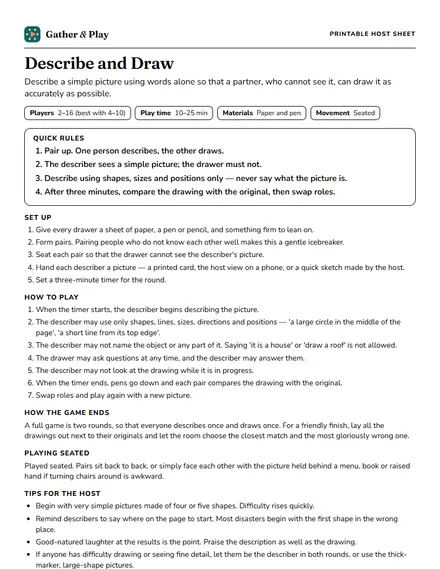
Describe and Draw — Printable host sheet
One page with the quick rules, set-up, and starter prompts — the same content as this page, laid out for print.
Where this game fits
We recommend Describe and Draw in these collections:
About this game
A common communication exercise often called "back-to-back drawing"; this explanation, the example and the picture descriptions are original to Gather & Play.
Editorially checked for clarity and consistency. We do not claim group playtesting for this page. Editorial policy.