Family Reunion Games: 10 Ideas That Work for Every Generation
A reunion brings together people aged eight to eighty who share a surname and not much recent history. These games give cousins, in-laws and great-aunts a reason to talk to each other — and nobody has to run.
The short answer
The best family reunion games mix generations and let everyone choose how active to be. Begin with Shared Connections in small mixed-age groups, play team Charades as the main event, then sit down for Describe and Draw and a round-the-table One-Word Story. Offer every game in its seated form without being asked.
The games we recommend
In a small group, find three things you all have in common that nobody could tell just by looking at you.
Why it fits: It scales to forty people without changing, and it deliberately puts different branches of the family in the same small group.
- 4–40 players
- 10–20 min
- No materials
- Standing optional
- Seated variation
Act out a word or phrase without speaking so your team can guess it before the timer runs out.
Why it fits: Every generation already half-knows it. Category rounds and seated-friendly prompts make it fair for a nine-year-old and a ninety-year-old on the same team.
- 4–20 players
- 20–45 min
- No materials
- Standing and moving
- Seated variation
Share three statements about yourself — two true, one invented — and see whether the group can spot the lie.
Why it fits: Relatives discover stories they have never heard. Played in clusters of five or six, it turns a big room into several good conversations.
- 3–12 players
- 10–30 min
- No materials
- Seated
- Works seated
Tell a story together, one word per person, and try to bring it to an ending that makes sense.
Why it fits: Even the youngest reader can add one word, and the three-word variation keeps small children involved.
- 3–12 players
- 5–20 min
- No materials
- Seated
- Works seated
Describe a simple picture using words alone so that a partner, who cannot see it, can draw it as accurately as possible.
Why it fits: Pairing a grandparent with a grandchild makes this the most quietly memorable game of the day.
- 2–16 players
- 10–25 min
- Paper and pen
- Seated
- Works seated
Choose between two alternatives, defend your choice, and find out who at the table thinks the way you do.
Why it fits: The hands-up version includes the whole room at once, whether there are twelve of you or forty.
- 2–30 players
- 10–30 min
- No materials
- Seated
- Works seated
Take turns naming things that fit a category, without repeating an answer or hesitating too long.
Why it fits: It needs nothing, takes two minutes a round, and can be played at each table while food is served.
- 3–12 players
- 10–25 min
- No materials
- Seated
- Works seated
The whole team acts out a prompt together while a single teammate tries to guess it.
Why it fits: Acting as a team means no child or shy adult is ever alone on stage.
- 6–24 players
- 15–35 min
- No materials
- Standing and moving
- Seated variation
Climb a three-step ladder of questions on one theme — from an easy opener to a more thoughtful one — so that a table of guests ends up in a real conversation.
Why it fits: The "learning", "home" and "celebrations" ladders draw out family stories without anyone giving a speech.
- 3–10 players
- 15–30 min
- No materials
- Seated
- Works seated
As a team, take an ordinary object from the room and pitch it to the party as a brilliant new invention with a completely different purpose.
Why it fits: Mixed-age teams inventing a ridiculous product from a kitchen spoon is where teenagers and grandparents genuinely collaborate.
- 4–30 players
- 20–40 min
- No materials
- Standing optional
- Seated variation
Compare the games at a glance
| Game | Players | Play time | Prep | Materials | Movement | Seated option | Energy |
|---|---|---|---|---|---|---|---|
| Shared Connections | 4–40 | 10–20 min | 1 min prep | No materials | Standing optional | Yes | Lively |
| Charades | 4–20 | 20–45 min | 3 min prep | No materials | Standing and moving | Yes | High energy |
| Two Truths and a Lie | 3–12 | 10–30 min | No prep | No materials | Seated | Yes | Calm |
| One-Word Story | 3–12 | 5–20 min | No prep | No materials | Seated | Yes | Lively |
| Describe and Draw | 2–16 | 10–25 min | 5 min prep | Paper and pen | Seated | Yes | Calm |
| Would You Rather | 2–30 | 10–30 min | No prep | No materials | Seated | Yes | Calm |
| Categories | 3–12 | 10–25 min | No prep | No materials | Seated | Yes | Lively |
| Reverse Charades | 6–24 | 15–35 min | 3 min prep | No materials | Standing and moving | Yes | High energy |
| Conversation Ladder | 3–10 | 15–30 min | No prep | No materials | Seated | Yes | Calm |
| Team Object Pitch | 4–30 | 20–40 min | 2 min prep | No materials | Standing optional | Yes | High energy |
Times are editorial estimates, not test results.
A two-hour reunion afternoon
Written for sixteen to twenty-four relatives in a hall, a garden or a large living room. For a bigger gathering, run the team games as two parallel games.
- Step 1 · 15 minutes
Shared Connections
As people arrive. Groups of three or four with at least two generations in each.
- Step 2 · 30 minutes
Charades
Mixed-age teams of four to six. Announce the category before every turn.
- Step 3 · 15 minutes
Describe and Draw
Everyone sits. Pair an older relative with a younger one.
- Step 4 · 10 minutes
One-Word Story
One story per table, three-word variation for small children.
- Step 5 · 10 minutes
Would You Rather
Whole-room hands-up version, finishing on a multigenerational question.
About 80 minutes in total. Times are editorial estimates, not test results.
How we chose these family reunion games
A reunion is not a party of friends. The guests did not choose each other, their ages span decades, and some have not met since the last wedding. That changes what a good game looks like. Each pick had to meet these requirements:
- It works across ages. A child who can read short words and an adult who has never played a party game can both take part on equal terms.
- It has a genuine seated form. Not “you can watch”, but a real way to play from a chair, described on every rules page.
- It mixes the family. The game should put different branches and generations together rather than letting cousins of the same age cluster.
- It needs no specialist knowledge. There is no trivia about films, music or sport that one generation knows and another does not.
- It scales. Reunions are large. Each game explains exactly how to split twelve, twenty-four or forty people.
Children take part here alongside the adults who brought them. None of these games asks a child to play unsupervised, and the page is written for the adult doing the organising.
Family reunion icebreaker games
The first half hour of a reunion decides the mood. People arrive in family units and stay in them unless something gives them a reason to move. These four icebreakers are the ones we would use, in order of how well people already know each other.
Shared Connections is the strongest family reunion icebreaker we know. Groups of three or four have four minutes to find three things they all have in common that nobody could see — and the rule that each group needs two generations does the mixing for you. The share-back (“we have all been locked out of our own homes this year”) gives the whole room something to laugh about.
Two Truths and a Lie works best in clusters of five or six, so that nobody waits long. Use the “themed rounds” variation with a family theme — school days or first jobs — and older relatives usually win, because their true stories are the hardest to believe. Our example sets show the pattern to anyone who is stuck.
Would You Rather, in its hands-up form, is the lowest-pressure option of all: nobody speaks unless they want to. It suits the moment when people are still finding seats.
Conversation Ladder is for smaller tables once people have settled. It moves from an easy question to a more thoughtful one, and anyone may pass.
For a game-free alternative, the multigenerational group in our icebreaker questions contains thirty questions such as “What is a family saying that everyone here would recognise?” — print them and leave a few on each table.
Splitting a big family into teams
The quickest fair method is to line people up by age — or by birthday month, which is kinder — and count off round the room: one, two, three, four, one, two, three, four. Each number is a team, and every team automatically contains a spread of ages.
| Family size | Team games | Circle games | Table games |
|---|---|---|---|
| 8–12 | Two teams | One circle | One table |
| 13–24 | Three or four teams of 4–6 | Two or three circles | Tables of six |
| 25–40 | Two parallel games, each with 3 teams | Circles of 6–8 | Tables of six, one host per table |
Above about twenty-four people, do not try to run one game for the whole room, with the exception of Shared Connections and hands-up Would You Rather. Our large-group collection explains the limits of each game in detail.
Making it comfortable for every generation
- Offer the seated version first, to everyone. When “you can do this from your chair” is the default, nobody has to ask for an exception.
- Let people watch. A relative who keeps score, holds the timer or judges “close enough” is taking part.
- Read prompts aloud when someone finds small print difficult, and use the large-print option on any printable.
- Keep rounds short. Small children and tired travellers both fade after about twenty minutes of one game.
- Avoid assumptions. Do not assign roles by age — plenty of grandparents want to act, and plenty of teenagers would rather keep score.
Our guide to adapting games for mixed ages covers reading support, team play and seated options in more depth.
Common mistakes at family reunions
- Starting before most people have arrived. Use an arrival game that latecomers can join.
- Letting branches of the family form their own teams. It turns play into a rivalry that may be older than the game.
- Choosing games that depend on recent pop culture. They split the room by age.
- Running games through the meal. Play before food and after it.
- Over-planning. Three games played well beat six played in a rush.
Quick answers
What are good games for a family reunion with all ages?
Shared Connections, team Charades with category rounds, Describe and Draw in grandparent–grandchild pairs, One-Word Story and hands-up Would You Rather all work from about age seven to any age. Each has a seated form, needs little or no equipment, and mixes generations on the same team.
How do you break the ice at a family reunion?
Put people into groups of three or four containing at least two generations and give them four minutes to find three things they all have in common. This is Shared Connections, and it works because the task is cooperative, short and impossible to do badly. Follow it with a whole-room Would You Rather.
What family reunion games need no equipment?
Shared Connections, Two Truths and a Lie, Would You Rather, One-Word Story, Categories and Conversation Ladder need nothing at all. Charades needs only prompts, which a host can read from one phone. See our games without props list for more.
How many games should you plan for a family reunion?
Plan four or five games of ten to thirty minutes each, and expect to drop one. A two-hour block with a break in the middle is enough for most families; the rest of the day belongs to food and conversation.
Prompts and printables for this occasion
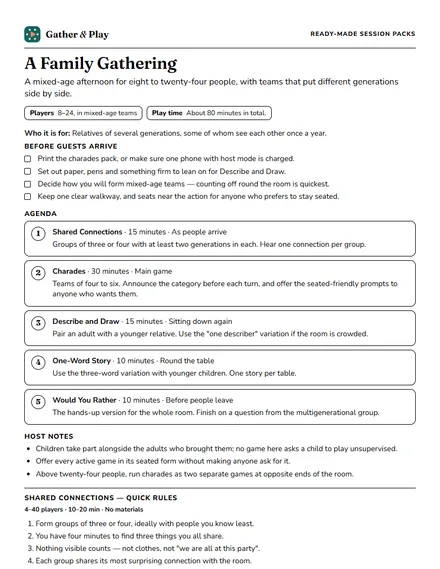
A Family Gathering
A mixed-age afternoon for eight to twenty-four people, with teams that put different generations side by side.