How to Play Story Remix
Retell a simple, everyday story in a surprising style — as a weather forecast, a sports commentary, a bedtime story — and let the group guess the style.
- 3–10 players
- 15–30 min
- No materials
- Lively
Quick rules
- Agree on a plain base story everyone knows — "making a cup of tea".
- Each storyteller secretly gets a style, such as "nature documentary".
- They retell the base story in that style for up to a minute.
- The first listener to guess the style scores, and so does the storyteller.
At a glance
- Players
- 3–10 players
- Best with
- 4–8
- Play time
- 15–30 min
- Prep
- 1 min prep
- Materials
- No materials
- Energy
- Lively
- Noise
- Moderate
- Movement
- Seated
- Seated option
- Works seated
- Where
- Living room, Dinner table, Small space, Outdoors
Times are editorial estimates, not test results.
Reading: The storyteller reads or hears one short style prompt in secret. Listeners read nothing.
Set up
What you need
Nothing. Voices only.
Nice to have:
- Base stories and style cards from the host view
- Choose a base story — an everyday sequence of four or five steps that everyone understands, such as catching a bus or washing a dog.
- Say the steps of the base story aloud once, so that everybody has the same version.
- Decide how styles are handed out: the host view on a phone, shown privately to the storyteller, or whispered by the player on their right.
- Choose the first storyteller — a volunteer, ideally.
How to play
- The storyteller receives a style in secret.
- They retell the base story in that style. All the steps of the base story should still happen, in order.
- The storyteller may not name the style or use its most obvious giveaway word — a sports commentator cannot say 'commentary' or 'match'.
- Listeners stay quiet until the storyteller finishes or one minute has passed, whichever comes first.
- Listeners then call out guesses. The first correct guess earns that listener a point, and the storyteller a point too.
- If nobody guesses within three attempts, the storyteller reveals the style and no points are scored.
- The correct guesser becomes the next storyteller. If they have already had a turn, play passes to the left.
Example round
The base story is "making a cup of tea" — fill the kettle, boil it, teabag in the cup, pour, add milk. Yusuf's secret style is "nature documentary". He lowers his voice. "Here, in the quiet of the early kitchen, the kettle waits. It has waited all night. Now, at last, water — and with it, purpose. Observe the teabag: small, patient, perfectly adapted to its environment…" By the time the milk "approaches cautiously from the fridge", Bea has shouted "Wildlife documentary!" A point each. Bea draws "airline safety announcement" and begins by indicating the exits from the kitchen.
How the game ends
Play until everyone has told the story once. Change the base story after four or five retellings so that it stays fresh. The highest score wins, though most groups stop counting after the first round and simply ask for more.
Group size: minimum, maximum and how to split
Story Remix needs at least 3 players and works for up to about 10. It is at its best with 4–8 players.
Each retelling takes about a minute, plus guessing, so ten players is the limit for one group. With more people, play in teams of 3–4 that prepare and perform one retelling together — a room of twenty-four becomes six short performances, which is a good length.
Playing seated. Storytellers perform from their seats. Standing up for your turn is optional theatre and is never part of the rules.
Tips for the host
- Go first yourself with an easy style — a bedtime story — to demonstrate that thirty seconds is plenty.
- Offer nervous storytellers a choice of two styles.
- Keep the base story extremely simple. The humour comes from the gap between a dull task and a grand style.
- Styles should be kinds of speech, not impressions of particular people. Imitating accents or individuals is off the table.
Variations
Change one thing
Instead of a style, each storyteller changes a single element — the setting becomes the Moon, the main character becomes a cat, everything happens backwards. Listeners guess what was changed.
Team remix
Teams of three or four perform together, each person taking one step of the base story in the shared style. The format suits large groups, and people who would rather not perform alone.
Prompts for this game
Plain base stories and the styles to retell them in. Styles are kinds of speech, never impressions of real people.
Base stories
- Making a cup of tea
- Catching a bus
- Washing a dog
- Making a sandwich
- Posting a letter
- Changing a light bulb
- Hanging up the washing
- Finding a lost sock
Styles
- A nature documentary
- A sports commentary
- A bedtime story
- An airline safety announcement
- A weather forecast
- A cooking programme
- A detective story
- A museum audio guide
- A breaking news report
- A fairy tale
- A motivational speech
- A film trailer
- An instruction manual
- A horse-racing commentary
Printable host sheet
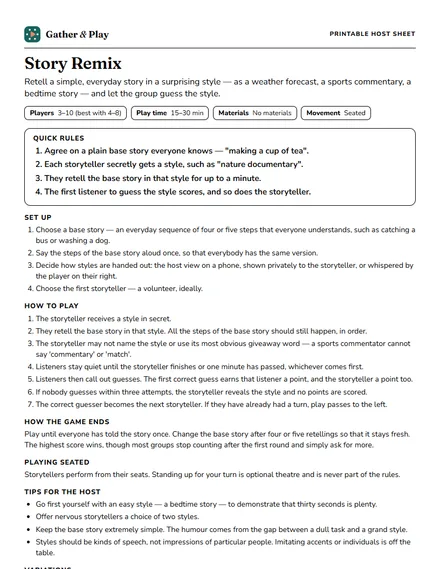
Story Remix — Printable host sheet
One page with the quick rules, set-up, and starter prompts — the same content as this page, laid out for print.
Where this game fits
We recommend Story Remix in these collections:
- Indoor Party Games for Adults: 9 Picks for Any Living Room
- Birthday Party Games for Adults: 9 Ideas Guests Actually Join In
- Party Games for Small Groups: 10 Games for 3 to 8 Players
- Party Games Without Props: 12 Games You Can Play With Nothing
- Halloween Party Games for Adults: 8 Friendly-Spooky Ideas
- Christmas Party Games for Adults: 8 Festive Ideas for Mixed Company
About this game
An original Gather & Play format drawing on common storytelling and improvisation exercises; all base stories and styles are original.
Editorially checked for clarity and consistency. We do not claim group playtesting for this page. Editorial policy.