Two Truths and a Lie Ideas: 60 Example Sets You Can Adapt
Sixty example sets that show what a good round looks like — two believable truths, one believable lie — each with a note on how to rewrite it using your own real details. They are patterns to borrow, not scripts to recite.
The short answer
The best Two Truths and a Lie ideas are small, specific and slightly surprising — "I have never owned an umbrella" is harder to judge than a dramatic story. This page gives 60 example sets with the sample lie marked and a tip for adapting each one. Always replace the examples with true facts about yourself.
These are patterns to rewrite with your own true details. Never present an example as a fact about your life — the game works because two statements really are true.
Two Truths and a Lie ideas about everyday habits
15 prompts-
- I set three alarms every morning.
- I have never owned an umbrella.
- I iron my socks.
Sample lie: “I iron my socks.”
How to adapt it: Swap in your real morning routine; keep the lie just as mundane. -
- I alphabetise my bookshelf.
- I talk to my houseplants.
- I have kept every cinema ticket since I was twelve.
Sample lie: “I have kept every cinema ticket since I was twelve.”
How to adapt it: Use two real habits and one collection you never started. -
- I always sit in the same seat on the bus.
- I have never finished a crossword.
- I write my shopping lists in rhyme.
Sample lie: “I write my shopping lists in rhyme.”
How to adapt it: The lie works because it is odd but harmless — invent your own. -
- I drink my tea cold on purpose.
- I check the weather four times a day.
- I have named my car.
Sample lie: “I have named my car.”
How to adapt it: Replace with real quirks about drinks, weather or belongings. -
- I can only sleep with socks on.
- I have used the same pen for six years.
- I fold my laundry the moment it is dry.
Sample lie: “I fold my laundry the moment it is dry.”
How to adapt it: Choose habits your friends would half believe. -
- I walk the same route every evening.
- I always read the last page of a book first.
- I have never hit the snooze button.
Sample lie: “I have never hit the snooze button.”
How to adapt it: A virtuous-sounding lie is hard to spot. -
- I count the stairs whenever I climb them.
- I keep a jar of buttons with no purpose.
- I listen to the same album every Monday.
Sample lie: “I listen to the same album every Monday.”
How to adapt it: Use your own small rituals. -
- I eat lunch at exactly the same time every day.
- I have a favourite spoon.
- I answer every phone call on the first ring.
Sample lie: “I answer every phone call on the first ring.”
How to adapt it: Make all three equally ordinary. -
- I have kept a diary for ten years.
- I cannot whistle.
- I make my bed before I do anything else.
Sample lie: “I make my bed before I do anything else.”
How to adapt it: Mix a long-running habit with something you cannot do. -
- I always carry a spare pair of shoelaces.
- I rehearse phone calls before I make them.
- I have never been late for a train.
Sample lie: “I have never been late for a train.”
How to adapt it: "Never" statements invite good questions. -
- I save the best bite of a meal for last.
- I organise my wardrobe by colour.
- I do a jigsaw puzzle every week.
Sample lie: “I do a jigsaw puzzle every week.”
How to adapt it: Swap in your real ways of organising things. -
- I keep my phone on silent all day.
- I water my plants on a strict schedule.
- I can say the alphabet backwards without stopping.
Sample lie: “I can say the alphabet backwards without stopping.”
How to adapt it: End with a small skill you do not have. -
- I always choose the window seat.
- I write letters to friends by hand.
- I polish my shoes every Sunday.
Sample lie: “I polish my shoes every Sunday.”
How to adapt it: Old-fashioned habits make believable lies. -
- I name the spiders in my home.
- I do the washing-up before I go to bed, without fail.
- I have not eaten a crisp in five years.
Sample lie: “I have not eaten a crisp in five years.”
How to adapt it: Use one silly truth so the lie looks sensible. -
- I take a photograph of every meal I cook.
- I never step on cracks in the pavement.
- I read the instructions before assembling anything.
Sample lie: “I read the instructions before assembling anything.”
How to adapt it: Pick habits people could ask a follow-up about.
Ideas about food and home
15 prompts-
- I have never eaten a hard-boiled egg.
- I put pepper on strawberries.
- I baked my own wedding cake.
Sample lie: “I baked my own wedding cake.”
How to adapt it: Keep the food truths strange and the lie impressive. -
- I once ate the same dinner for two weeks.
- I cannot stand the smell of melon.
- I grow my own chillies on a windowsill.
Sample lie: “I grow my own chillies on a windowsill.”
How to adapt it: Use real likes, dislikes and one garden you do not have. -
- I have burnt toast three times in a single morning.
- I own eleven wooden spoons.
- I make my own bread every week.
Sample lie: “I make my own bread every week.”
How to adapt it: A wholesome lie is rarely challenged. -
- I have a recipe I refuse to share.
- I eat pizza crust-first.
- I have never tasted peanut butter.
Sample lie: “I have never tasted peanut butter.”
How to adapt it: "Never tasted" is easy to adapt to any common food. -
- I learned to cook from a library book.
- I keep ketchup in the cupboard, not the fridge.
- I once won a pie-eating contest.
Sample lie: “I once won a pie-eating contest.”
How to adapt it: Swap the contest for any unlikely small victory. -
- My fridge contains four kinds of mustard.
- I have eaten breakfast for dinner all week.
- I can chop an onion without crying.
Sample lie: “I can chop an onion without crying.”
How to adapt it: Choose kitchen facts that sound like boasts. -
- I drink a glass of milk every night.
- I have never used a microwave.
- I put salt in my coffee.
Sample lie: “I put salt in my coffee.”
How to adapt it: One slightly unbelievable truth hides the lie. -
- I painted my front door without asking anyone.
- I have lived in the same street all my life.
- I built my own kitchen table.
Sample lie: “I built my own kitchen table.”
How to adapt it: Use real facts about your home and one project you never did. -
- I have moved house nine times.
- I sleep with the window open all winter.
- I have a room I have never decorated.
Sample lie: “I have a room I have never decorated.”
How to adapt it: Numbers make statements feel checkable. -
- I once lived above a bakery.
- I have never owned a television.
- My home has a door that leads nowhere.
Sample lie: “My home has a door that leads nowhere.”
How to adapt it: Homes are full of odd truths — list yours. -
- I always eat dessert first when I am at home.
- I keep a herb garden in old teapots.
- I have a cellar full of homemade jam.
Sample lie: “I have a cellar full of homemade jam.”
How to adapt it: Make the lie cosy and specific. -
- I have a favourite mug that nobody else may use.
- I hate the texture of mushrooms.
- I once cooked dinner for forty people.
Sample lie: “I once cooked dinner for forty people.”
How to adapt it: The scale of the lie should stay plausible. -
- I have eaten at the same café every Saturday for years.
- I cannot cook rice without burning it.
- I roast my own coffee beans.
Sample lie: “I roast my own coffee beans.”
How to adapt it: Combine a routine, a weakness and a false expertise. -
- I collect cookbooks but never follow recipes.
- I once dropped a whole trifle at a party.
- I have never eaten a meal in bed.
Sample lie: “I have never eaten a meal in bed.”
How to adapt it: Embarrassing truths make the game friendlier. -
- I hang my washing in a particular order.
- I rearrange my furniture every season.
- I assembled a wardrobe with no leftover screws.
Sample lie: “I assembled a wardrobe with no leftover screws.”
How to adapt it: End on a triumph nobody quite believes.
Ideas about places and travel
15 prompts-
- I once drove four hours to buy a second-hand accordion.
- I have never been on a ferry.
- I have slept in a lighthouse.
Sample lie: “I have slept in a lighthouse.”
How to adapt it: Swap in a real long trip made for a silly reason. -
- I got lost in my own town last year.
- I have been to the same beach every summer since childhood.
- I have crossed a border on foot.
Sample lie: “I have crossed a border on foot.”
How to adapt it: Keep places general — no need to name them. -
- I have never flown in a plane.
- I once missed a train by ten seconds.
- I have swum in three different seas.
Sample lie: “I have swum in three different seas.”
How to adapt it: Counts of things are easy to adapt. -
- I learned to ride a bicycle as an adult.
- I have camped in the snow.
- I have travelled for a whole day by bus.
Sample lie: “I have travelled for a whole day by bus.”
How to adapt it: Choose journeys that prompt a story. -
- I have been to a wedding in a country where I knew nobody.
- I get seasick in a rowing boat.
- I have walked across a whole city in one day.
Sample lie: “I have walked across a whole city in one day.”
How to adapt it: One social truth, one weakness, one feat. -
- I once took the wrong train and stayed for lunch.
- I have never seen the sea in winter.
- I can read a paper map properly.
Sample lie: “I can read a paper map properly.”
How to adapt it: A dull-sounding skill makes a clever lie. -
- I have climbed a hill before sunrise.
- I always pack two days before I travel.
- I have never lost a suitcase.
Sample lie: “I have never lost a suitcase.”
How to adapt it: Pair an adventure with your packing habits. -
- I have lived in three different cities.
- I have a favourite bench in a park.
- I once slept through my station and woke at the end of the line.
Sample lie: “I once slept through my station and woke at the end of the line.”
How to adapt it: Everyday travel mishaps work best. -
- I have ridden a horse on a beach.
- I am afraid of escalators.
- I have been inside a cave with no torch.
Sample lie: “I have been inside a cave with no torch.”
How to adapt it: Avoid real fears you would rather not discuss. -
- I once went on holiday and it rained every day.
- I have never built a sandcastle.
- I have picnicked on a mountain top.
Sample lie: “I have picnicked on a mountain top.”
How to adapt it: Weather and picnics suit any age group. -
- I know the way to my grandparents' old house by heart.
- I have never taken a taxi alone.
- I have been to a place that is not on most maps.
Sample lie: “I have been to a place that is not on most maps.”
How to adapt it: A slightly mysterious lie invites questions. -
- I have watched a sunrise and a sunset over water on the same day.
- I once left my shoes on a train.
- I can sleep anywhere, even standing.
Sample lie: “I can sleep anywhere, even standing.”
How to adapt it: Finish with a talent that would be useful if true. -
- I visited the same museum five times in one year.
- I have never ridden a tram.
- I have sailed a small boat by myself.
Sample lie: “I have sailed a small boat by myself.”
How to adapt it: Mix city truths with an outdoor lie. -
- I once walked home in a snowstorm.
- I always choose the aisle seat.
- I have stayed in a hotel made of ice.
Sample lie: “I have stayed in a hotel made of ice.”
How to adapt it: The lie can be exotic if the truths are plain. -
- I have a town I return to every year.
- I once cycled further than I meant to and needed rescuing.
- I have never been camping.
Sample lie: “I have never been camping.”
How to adapt it: Flip which statement is the lie to suit your life.
Ideas about skills and school days
15 prompts-
- I can juggle three oranges.
- I failed my first driving test.
- My first job was painting lines on a tennis court.
Sample lie: “My first job was painting lines on a tennis court.”
How to adapt it: First jobs are perfect lie material. -
- I played the recorder in a school concert.
- I can touch my nose with my tongue.
- I won a prize for handwriting.
Sample lie: “I won a prize for handwriting.”
How to adapt it: School prizes are hard to check. -
- I learned to swim when I was nineteen.
- I can fold a paper crane from memory.
- I was the captain of a chess team.
Sample lie: “I was the captain of a chess team.”
How to adapt it: One late-learned skill, one party trick, one false title. -
- I once forgot my lines in a school play.
- I can name every tool in a toolbox.
- I had perfect attendance for a whole school year.
Sample lie: “I had perfect attendance for a whole school year.”
How to adapt it: Use a real stage memory if you have one. -
- I know how to knit but not how to stop.
- I can do a cartwheel.
- I taught myself to juggle from a library book.
Sample lie: “I taught myself to juggle from a library book.”
How to adapt it: Half-finished skills are funny and true. -
- I was in a choir for five years.
- I cannot ride a skateboard.
- I once built a working radio.
Sample lie: “I once built a working radio.”
How to adapt it: Keep the technical lie modest. -
- I can type without looking at the keys.
- I never learned to tell left from right quickly.
- I won a sack race at school.
Sample lie: “I won a sack race at school.”
How to adapt it: Sports-day lies are safe and cheerful. -
- I can recite a poem I learned when I was eight.
- I have terrible sense of rhythm.
- I can play one song on the piano with both hands.
Sample lie: “I can play one song on the piano with both hands.”
How to adapt it: Swap in your own party piece. -
- I was once locked in a library after closing time.
- I can whistle two notes at once.
- I hold a certificate in first aid.
Sample lie: “I hold a certificate in first aid.”
How to adapt it: A practical qualification is a believable lie. -
- I repeated a science experiment until it finally worked.
- I am very good at untangling knots.
- I was always picked first for team games.
Sample lie: “I was always picked first for team games.”
How to adapt it: Pair a persistence story with a tiny talent. -
- I can draw a convincing horse.
- I cannot snap my fingers.
- I read an entire encyclopaedia volume for fun.
Sample lie: “I read an entire encyclopaedia volume for fun.”
How to adapt it: Choose things people can ask you to prove — or not. -
- I started learning a language last year.
- I once got full marks on a test by accident.
- I can identify ten birds by their song.
Sample lie: “I can identify ten birds by their song.”
How to adapt it: Nature knowledge makes a tidy lie. -
- I was taught to sew by my grandfather.
- I can stand on one leg for five minutes.
- I have never forgotten a birthday.
Sample lie: “I have never forgotten a birthday.”
How to adapt it: Mix a family skill with a bold "never". -
- I kept a pet snail in my school desk.
- I can parallel park in one attempt.
- I was the fastest reader in my class.
Sample lie: “I was the fastest reader in my class.”
How to adapt it: School-day oddities beat grand claims. -
- I wrote a newspaper for my street as a child.
- I am hopeless at remembering jokes.
- I can solve a puzzle cube in under two minutes.
Sample lie: “I can solve a puzzle cube in under two minutes.”
How to adapt it: End with a skill someone might ask to see.
How to use these examples — and how not to
These are examples to customise, not statements to present as your own. The game only works when two of your three statements are genuinely true about you. If you read out an example set as it stands, you would be telling three lies, and nobody could ever guess correctly.
So use each set as a pattern:
- Read a set and notice its shape — for instance, a habit, something you have never done, and a small skill.
- Replace the two truths with real facts about you that fit the same shape.
- Invent a lie that sounds exactly as ordinary as your truths.
- Use the adaptation note under each set as a prompt.
Example. The pattern “I set three alarms every morning / I have never owned an umbrella / I iron my socks” might become, for you: “I eat the same breakfast every day” (true), “I have never broken a bone” (true), “I make my bed before I do anything else” (the lie).
The complete Two Truths and a Lie rules explain the voting, the follow-up questions and an optional scoring system. In host mode, the sample lie stays hidden until you choose to reveal it, so a group can practise guessing on the examples.
What makes a good lie
The instinct is to invent something dramatic. It is nearly always a mistake: a dramatic lie stands out against two modest truths.
- Match the size of your truths. If your truths are about breakfast and umbrellas, your lie should be about socks, not skydiving.
- Make it specific. “I have been to a lot of places” is vague. “I have crossed a border on foot” sounds like a memory.
- Borrow from near-truths. Something you almost did, something a sibling did, or something you would like to be true.
- Avoid what the room can check. If your sister is at the table, do not lie about your childhood pet.
- Keep your voice level. Say all three in the same tone and at the same speed.
What makes a good truth
The best truths are the ones people assume are lies.
- Small and odd beats big and impressive. “I can only sleep with socks on” is perfect. Achievements can sound like boasting, and among strangers they change the mood.
- “Never” statements are powerful. “I have never eaten a hard-boiled egg” is simple, harmless, and hard to believe.
- Choose truths with a story behind them. After the reveal, you will be asked to tell it. That story is the real point of the game.
Keeping it comfortable
This is a game about choosing what to share, so the choice must stay with each player.
- Nothing sensitive. Do not use statements about health, relationships, money, legal trouble, beliefs or anything else that you — or anyone listening — might later wish had stayed private. None of the examples on this page touches those subjects.
- Nothing about other people in the room unless they have agreed.
- For work or new groups, use a theme — food, places or school days — to keep statements light. The four groups on this page are safe themes.
- Anyone may pass, or take their turn later.
If your group would prefer no deception at all, play Two Truths and a Wish: replace the lie with something you wish were true.
Ideas by setting
- At work or with new acquaintances: use everyday habits and food and home. See icebreaker games for adults.
- Family gatherings: skills and school days delights younger relatives, because grandparents’ truths are the hardest to believe. See family reunion games.
- Birthdays: make every statement about the guest of honour — described in birthday party games for adults.
- Dinner parties: one round between courses, as in our dinner party games running order.
Quick answers
What are good ideas for Two Truths and a Lie?
Good ideas are small, specific facts: a habit (“I count the stairs whenever I climb them”), something you have never done (“I have never been on a ferry”), a minor skill (“I can fold a paper crane from memory”). Pair two real ones with a lie of the same size.
What is a good lie for Two Truths and a Lie?
A good lie is ordinary, specific and impossible to check — “My first job was painting lines on a tennis court” or “I make my own bread every week”. It should sound exactly as modest as your truths, and be said in the same tone.
What are safe Two Truths and a Lie ideas for work?
Use neutral themes: food, travel, hobbies, school days and everyday routines. Avoid anything about health, relationships, money or beliefs. “I have never owned a television”, “I once missed a train by ten seconds” and “I can juggle three oranges” are the right register.
How do you win at Two Truths and a Lie?
Make your truths surprising and your lie boring. Most players guess that the strangest statement is the lie, so choosing an unusual true fact and a dull false one fools more people. Answer follow-up questions calmly, as though all three were true.
Print this pack
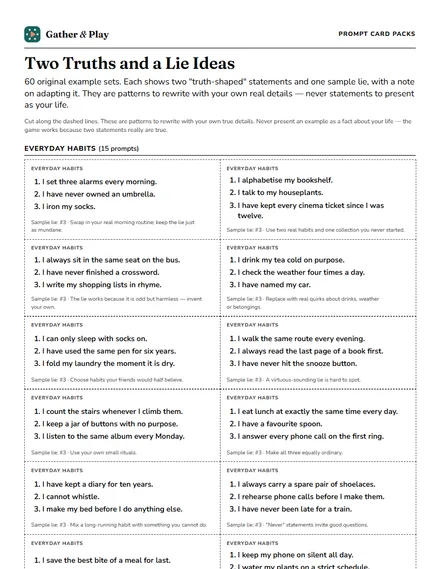
Two Truths and a Lie Ideas
60 original example sets. Each shows two "truth-shaped" statements and one sample lie, with a note on adapting it. They are patterns to rewrite with your own real details — never statements to present as your life.