How to Play Categories
Take turns naming things that fit a category, without repeating an answer or hesitating too long.
- 3–12 players
- 10–25 min
- No materials
- Lively
Quick rules
- Someone names a category, such as "things in a toolbox".
- Go round the circle; each player names one thing that fits.
- No repeats, and no pauses longer than about five seconds.
- Miss, repeat or stall and you lose a life. Last player with a life wins.
At a glance
- Players
- 3–12 players
- Best with
- 4–8
- Play time
- 10–25 min
- Prep
- No prep
- Materials
- No materials
- Energy
- Lively
- Noise
- Moderate
- Movement
- Seated
- Seated option
- Works seated
- Where
- Dinner table, Living room, Small space, Outdoors, Large room
Times are editorial estimates, not test results.
Reading: None. Categories are announced aloud.
Set up
What you need
Nothing. Voices only.
Nice to have:
- Category ideas from the host view
- Sit in a circle or around a table so the order of turns is obvious.
- Give every player three "lives" — three fingers held up is the easiest way to track them.
- Choose the first category-setter. Broad categories suit a first round — fruit, countries, things that are blue.
- Agree on the pause limit. A slow count of five by the player who has just answered is fair and needs no timer.
How to play
- The category-setter announces a category and gives the first answer.
- Moving clockwise, each player gives one new answer that fits.
- A player loses a life if they repeat an earlier answer, give something that does not fit, or fail to answer within the pause limit.
- Any player may challenge an answer. The group decides quickly by show of hands; a tie favours the answer.
- When a life is lost, the round ends. The player who lost it sets the next category and starts.
- A player with no lives left is out but becomes a judge for challenges.
- The last player with at least one life wins.
Example round
Category — "things you might find in a picnic basket". Leo: "Sandwiches." Marta: "A blanket." Chidi: "Grapes." Wren: "A corkscrew." Leo: "Napkins." Marta: "Ants!" — challenged at once. The table votes: ants arrive at a picnic, but nobody packs them, so the challenge stands and Marta folds down a finger. She sets the next category, "words that end in -ing", and the pace picks up immediately. Three categories later Chidi is counted out on "things with wheels" after someone has already taken "suitcase".
How the game ends
The game ends when only one player has lives remaining. For a shorter game give everyone two lives, or drop elimination entirely and play ten categories, with the player who lost the fewest lives declared the winner.
Group size: minimum, maximum and how to split
Categories needs at least 3 players and works for up to about 12. It is at its best with 4–8 players.
In one circle, twelve is the practical limit — after that the easy answers are gone before the last players get a turn. For bigger groups, form circles of 5–7 and give every circle the same category at the same moment; the last player standing in each circle joins a short "final" in front of everyone.
Playing seated. Played seated by default. The optional clap rhythm uses hands only.
Tips for the host
- Narrow the categories as the game goes on — "animals" early, "animals with stripes" later.
- Be generous on challenges in mixed-age groups. The aim is momentum, not a courtroom.
- If elimination leaves people sitting out for too long, switch to the no-elimination scoring described above.
- Avoid categories that depend on knowing particular brands, shows or celebrities, which shut out some guests.
Variations
Letter lock
Every answer must begin with the same letter — "foods beginning with P". Much harder, and best saved for the final two or three players.
Clap rhythm
Keep a steady four-beat pattern — two taps on the table, two claps — and give each answer on the claps. The rhythm replaces the pause limit and adds pressure without needing a timer.
Prompts for this game
Category ideas that do not depend on brands, celebrities or local knowledge.
Broad openers
- things in a picnic basket
- things you find in a toolbox
- things that are round
- animals with four legs
- things you take on holiday
- foods you eat with your hands
- things in a kitchen drawer
- things that make a noise
Narrower challenges
- things with wheels
- words that end in -ing
- things you can fold
- vegetables that grow underground
- things that are both a colour and an object
- musical instruments you blow
- things you only do once a year
- things that melt
- jobs that need a uniform
- things that come in pairs
Printable host sheet
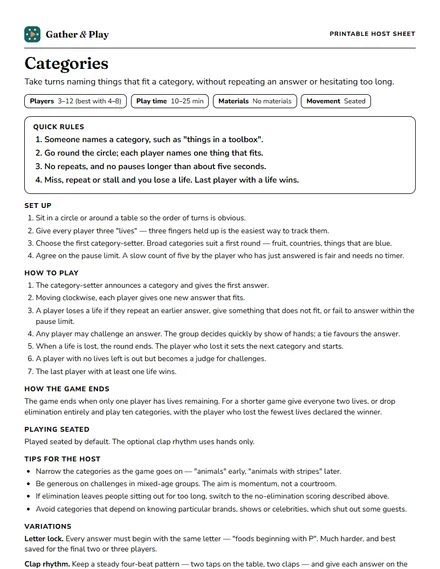
Categories — Printable host sheet
One page with the quick rules, set-up, and starter prompts — the same content as this page, laid out for print.
Where this game fits
We recommend Categories in these collections:
- Dinner Party Games: 8 Table Games Nobody Has to Leave Their Seat For
- Family Reunion Games: 10 Ideas That Work for Every Generation
- Party Games Without Props: 12 Games You Can Play With Nothing
- Indoor Games for Large Groups: 8 That Still Work With 30 People
- Party Games for Seniors: 10 Seated, Sociable Games for Older Adults
About this game
Traditional spoken word game played under many names; this explanation, the example and the category list are original to Gather & Play.
Editorially checked for clarity and consistency. We do not claim group playtesting for this page. Editorial policy.