Dinner Party Games: 8 Table Games Nobody Has to Leave Their Seat For
Games for the table itself — seated, spoken, and easy to pause when the food arrives. Nothing here needs a cleared room, a deck of cards, or a guest who is "good at games".
The short answer
The best dinner party games are seated, voice-only and easy to interrupt. Start with Would You Rather while drinks are poured, let Secret Word Detective run through the main course, play Odd One Out before dessert, and finish with one Conversation Ladder over coffee. Each takes ten to twenty-five minutes.
The games we recommend
Climb a three-step ladder of questions on one theme — from an easy opener to a more thoughtful one — so that a table of guests ends up in a real conversation.
Why it fits: It is built for a table. Three questions on one theme move guests from small talk to a real conversation, and anyone can pass without explaining.
- 3–10 players
- 15–30 min
- No materials
- Seated
- Works seated
Choose between two alternatives, defend your choice, and find out who at the table thinks the way you do.
Why it fits: It needs no explanation at all, so it works in the first ten minutes while people are still arriving and sitting down.
- 2–30 players
- 10–30 min
- No materials
- Seated
- Works seated
Slip your secret word into ordinary conversation without being caught — and catch other players slipping in theirs.
Why it fits: It runs in the background of the meal. Guests keep eating and talking while trying to slip an odd word into the conversation.
- 4–12 players
- 20–60 min
- No materials
- Seated
- Works seated
Hear four things, decide which one does not belong, and convince the table that your reason is the best one.
Why it fits: Short, self-contained rounds fit neatly between courses, and the argument about a wheelbarrow involves the whole table at once.
- 3–12 players
- 10–25 min
- No materials
- Seated
- Works seated
Share three statements about yourself — two true, one invented — and see whether the group can spot the lie.
Why it fits: It gives each guest two minutes of friendly attention, which is the quickest way for a mixed table to learn something about everyone.
- 3–12 players
- 10–30 min
- No materials
- Seated
- Works seated
Work out a secret person, place or thing by asking no more than twenty yes-or-no questions.
Why it fits: It is quiet enough for a restaurant or a small flat, and a round can be dropped the moment plates arrive.
- 2–10 players
- 10–25 min
- No materials
- Seated
- Works seated
Take turns naming things that fit a category, without repeating an answer or hesitating too long.
Why it fits: It lifts the energy after a heavy course without anyone standing up, and one round takes less than two minutes.
- 3–12 players
- 10–25 min
- No materials
- Seated
- Works seated
Build one story as a group, a sentence at a time, with every sentence accepting what came before and adding something new.
Why it fits: A shared story is a gentle way to end the evening, especially when nobody wants anything competitive.
- 3–10 players
- 10–20 min
- No materials
- Seated
- Works seated
Compare the games at a glance
| Game | Players | Play time | Prep | Materials | Movement | Seated option | Energy |
|---|---|---|---|---|---|---|---|
| Conversation Ladder | 3–10 | 15–30 min | No prep | No materials | Seated | Yes | Calm |
| Would You Rather | 2–30 | 10–30 min | No prep | No materials | Seated | Yes | Calm |
| Secret Word Detective | 4–12 | 20–60 min | 3 min prep | No materials | Seated | Yes | Calm |
| Odd One Out | 3–12 | 10–25 min | No prep | No materials | Seated | Yes | Calm |
| Two Truths and a Lie | 3–12 | 10–30 min | No prep | No materials | Seated | Yes | Calm |
| Twenty Questions | 2–10 | 10–25 min | No prep | No materials | Seated | Yes | Calm |
| Categories | 3–12 | 10–25 min | No prep | No materials | Seated | Yes | Lively |
| Yes-And Story | 3–10 | 10–20 min | No prep | No materials | Seated | Yes | Calm |
Times are editorial estimates, not test results.
A running order for a three-course dinner
This is the order we would use for six to eight guests. It leaves the main course mostly free for ordinary conversation, because a dinner party is a meal first and a game night second.
- Step 1 · 10 minutes
Would You Rather
While drinks are poured. Five questions from the everyday-choices group; latecomers can join mid-question.
- Step 2 · 25 minutes
Secret Word Detective
Hand out the words as the starter arrives and let the game run quietly through the main course.
- Step 3 · 15 minutes
Odd One Out
Between main course and dessert. Reveal the secret words first, then play six sets.
- Step 4 · 20 minutes
Conversation Ladder
With dessert or coffee. One ladder only — end while people still have things to say.
About 70 minutes in total. Times are editorial estimates, not test results.
How we chose these dinner table games
A dinner table is an unusual place to play. Everyone is seated in a fixed position, hands are busy, glasses are within elbow range, and the main event — the food — arrives on its own schedule. A game that works brilliantly in a living room can fail completely here. So every game on this page had to pass four tests:
- It is played entirely from a chair. Nobody stands, swaps seats, or acts anything out between the candles.
- It needs nothing on the table. No cards to deal, no paper to pass, no phone for every guest. At most, the host glances at one phone.
- It can be paused without damage. When the main course lands, the game simply stops and resumes — or doesn’t.
- It involves the whole table at once. At a table of eight, a game where two people play while six watch is a conversation killer.
We left out several good games for failing one of these. Charades needs a stage. Describe and Draw needs paper and elbow room. They belong in our indoor party games collection instead.
When to play: before, between, and after courses
The mistake most hosts make is to announce “games” as a separate block after dessert, when half the table is thinking about the journey home. Dinner table games work better as short interludes that fill natural gaps.
Before the starter is the awkward ten minutes when some guests are seated and others are still arriving. A game with no set-up and no memory — Would You Rather is ideal — gives the early guests something to do and lets latecomers join mid-question.
During the main course, do not run an active game at all. People want to eat and talk. This is the moment for a background game such as Secret Word Detective, which sits underneath the conversation rather than replacing it.
Between main course and dessert is the best slot of the evening. Plates are cleared, glasses are refilled, and people have fifteen minutes of attention to give. Use it for something with a little energy: Odd One Out or Categories.
With coffee, slow down. A single Conversation Ladder or a Yes-And Story ends the night warmly instead of competitively.
Matching the game to the table
| Your table | Start with | Avoid |
|---|---|---|
| Close friends | Secret Word Detective, Odd One Out | Long explanations — they will talk over you |
| Guests who have just met | Would You Rather, Two Truths and a Lie | Anything that needs shared history |
| Several generations | Twenty Questions, Categories | Fast word games with a strict timer |
| A long table of ten or more | Conversation Ladder in two halves | Any game where everyone answers every round |
| A restaurant or thin-walled flat | Twenty Questions, Conversation Ladder | Categories with the clap rhythm |
A long table deserves a special note. Above ten people, guests at opposite ends cannot hear each other, and a single game for the whole table turns into shouting. Split the table in half and let each half play its own round; the large-group collection explains how to split most games cleanly.
Dinner party games for guests who do not know each other
When a table mixes friendship groups, the first job of a game is to give people something safe to say. Choose games where there is no wrong answer and no need to be funny on demand. Would You Rather only asks for a preference. Two Truths and a Lie asks for three small facts, and our example sets show how ordinary those facts can be.
Say one sentence aloud before the first game: anyone can pass on anything, and nobody needs to explain why. It costs nothing, and it changes how relaxed quieter guests feel for the rest of the evening. Our guide to games for guests who do not know each other goes further into low-pressure introductions.
If you would rather skip a game entirely and simply steer the talk, the dinner-table group in our icebreaker questions has thirty questions written for exactly this.
Common mistakes with games at dinner
- Explaining for too long. If the rules take more than a minute, the food is getting cold. Play one open round and explain as you go.
- Keeping score all evening. A running total turns dinner into a contest. Score a single game if the table enjoys it, then let it go.
- Choosing a game the host loves and the guests don’t. Offer two options and let the table choose.
- Forcing a full round. With eight guests, “everyone takes a turn” can last forty minutes. Announce a time limit rather than a number of rounds.
- Playing through the main course. Let people eat.
Quick answers
What games can you play at the dinner table without any props?
Would You Rather, Two Truths and a Lie, Twenty Questions, Categories, Odd One Out, Conversation Ladder and Yes-And Story all work with voices only. The host can read prompts from one phone, but nothing is passed around and nothing sits on the table. Our no-equipment collection lists twelve such games.
How many games should you plan for a dinner party?
Plan three short games and expect to play two. A dinner party runs on conversation, and a game is there to restart it when it stalls. Ten to twenty minutes per game is plenty; stop each one while guests are still enjoying it.
What is a good game for a dinner party of six?
For six people, Odd One Out and Conversation Ladder are the strongest choices: everyone speaks in every round, turns come round quickly, and neither needs teams. With six close friends, add Secret Word Detective through the main course.
Are dinner party games suitable for older relatives?
Yes — every game on this page is seated and spoken, with no reading required from players and no time pressure unless you add it. Our collection of party games for older adults explains which variations work best around a family table.
Prompts and printables for this occasion
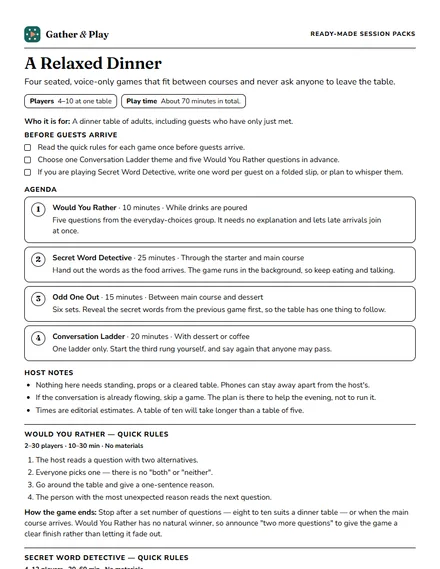
A Relaxed Dinner
Four seated, voice-only games that fit between courses and never ask anyone to leave the table.