How to Play Odd One Out
Hear four things, decide which one does not belong, and convince the table that your reason is the best one.
- 3–12 players
- 10–25 min
- No materials
- Calm
Quick rules
- The reader names four things.
- Everyone silently picks the one that does not belong — and a reason.
- Take turns making your case in one or two sentences.
- The reader awards a point to the most convincing or most inventive argument.
At a glance
- Players
- 3–12 players
- Best with
- 4–8
- Play time
- 10–25 min
- Prep
- No prep
- Materials
- No materials
- Energy
- Calm
- Noise
- Moderate
- Movement
- Seated
- Seated option
- Works seated
- Where
- Dinner table, Living room, Small space, Outdoors
Times are editorial estimates, not test results.
Reading: The reader says the four items aloud. Other players do not need to read.
Set up
What you need
Nothing. Voices only.
Nice to have:
- Sets of four from the host view
- Choose the first reader. Use a set from the host view, or invent four things that are similar but not identical.
- Make the main point clear before you start: there is no official answer. Any of the four can be the odd one out if the reason is good.
- Decide how many rounds to play. One round per player, so everyone reads once, is a natural length.
How to play
- The reader says the four items twice, slowly.
- Players think in silence for about twenty seconds.
- On a count of three, everyone holds up one, two, three or four fingers to show their pick.
- Starting to the reader's left, each player explains their choice in one or two sentences.
- A player may not reuse a reason already given. If someone has taken yours, you must find another — or argue for a different item.
- The reader awards one point to the argument they found most convincing and may give a second point for the most inventive.
- The player who won the main point becomes the next reader.
Example round
Jun reads: "A bicycle, a wheelbarrow, a shopping trolley, a skateboard." Fingers go up — two for the wheelbarrow, one for the bicycle, one for the skateboard. Petra: "Wheelbarrow — it is the only one with a single wheel." Amara also chose the wheelbarrow but her reason is gone, so she switches: "Then the shopping trolley. It is the only one you are not supposed to take home." Lars: "Bicycle — the only one you sit on." Dev: "Skateboard — the only one that carries nothing but a person." Jun gives the main point to Amara's trolley and the inventive point to Dev. Amara reads next.
How the game ends
Play until everyone has been the reader once, then total the points. For a quicker game, play six sets and stop. Ties are settled with one more set, judged by a player who is not involved in the tie.
Group size: minimum, maximum and how to split
Odd One Out needs at least 3 players and works for up to about 12. It is at its best with 4–8 players.
With more than twelve, hearing every argument takes too long. Play in teams of 3–4 that confer for thirty seconds and present one answer each, or split into separate tables of 5–6 that each have their own reader.
Playing seated. Played seated by default. No step requires standing or moving.
Tips for the host
- Sets work best when the four items are close cousins. If one is obviously different, the round is over in seconds.
- Reward reasoning rather than knowledge. An argument everybody can follow beats an obscure fact.
- Readers should explain their judging in a few words — "I had not thought of that" is enough.
- In mixed-age groups, let younger players argue first so that the simple reasons are still available.
Variations
Defend the unpicked
After the reveal, any item that nobody chose is assigned to the reader, who must argue that it is the true odd one out. It keeps the reader involved in every round.
Build a set
Instead of using prepared sets, each player in turn adds one item to the set — four players, four items — and then the whole table argues as usual. It works well once the group understands what makes a set interesting.
Prompts for this game
Sets of four close cousins. There is no official answer — any item can be the odd one out with a good reason.
Sets of four
- a bicycle · a wheelbarrow · a shopping trolley · a skateboard
- a teapot · a kettle · a watering can · a jug
- a candle · a torch · a lighthouse · a firefly
- a violin · a guitar · a harp · a piano
- a letter · a postcard · a parcel · a telegram
- a river · a canal · a lake · a puddle
- a carrot · a potato · a tomato · an onion
- an umbrella · a tent · a hat · a roof
- a clock · a calendar · a sundial · an hourglass
- a ladder · a staircase · a lift · a rope
- a bee · a butterfly · a bat · a kite
- bread · cheese · yoghurt · jam
- a bench · a stool · a sofa · a swing
- a whistle · a bell · a drum · a doorbell
- a map · a compass · a signpost · a guidebook
- a scarf · a belt · a tie · a ribbon
Printable host sheet
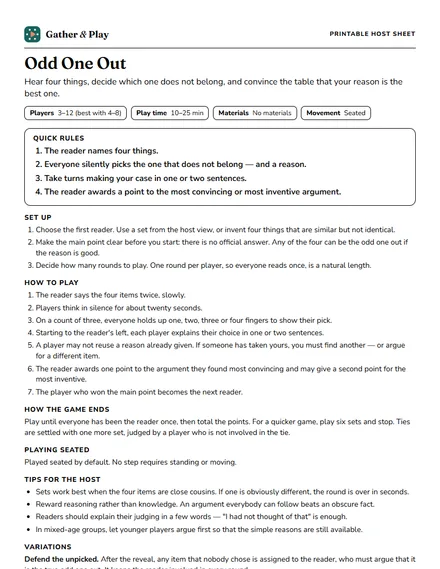
Odd One Out — Printable host sheet
One page with the quick rules, set-up, and starter prompts — the same content as this page, laid out for print.
Where this game fits
We recommend Odd One Out in these collections:
- Dinner Party Games: 8 Table Games Nobody Has to Leave Their Seat For
- Indoor Party Games for Adults: 9 Picks for Any Living Room
- Party Games for Small Groups: 10 Games for 3 to 8 Players
- Party Games Without Props: 12 Games You Can Play With Nothing
- Party Games for Seniors: 10 Seated, Sociable Games for Older Adults
- Icebreaker Games for Adults: 8 Low-Pressure Ways to Start
About this game
Based on the common "which one does not belong" puzzle format; the open-argument scoring, this explanation, the example and all sets are original to Gather & Play.
Editorially checked for clarity and consistency. We do not claim group playtesting for this page. Editorial policy.