How to Play Twenty Questions
Work out a secret person, place or thing by asking no more than twenty yes-or-no questions.
- 2–10 players
- 10–25 min
- No materials
- Calm
Quick rules
- One player thinks of something and says only whether it is a person, place or thing.
- The others take turns asking yes-or-no questions — twenty in total.
- Anyone may use their turn to make a guess instead.
- Guess it within twenty and the guessers win; otherwise the answerer does.
At a glance
- Players
- 2–10 players
- Best with
- 3–6
- Play time
- 10–25 min
- Prep
- No prep
- Materials
- No materials
- Energy
- Calm
- Noise
- Quiet
- Movement
- Seated
- Seated option
- Works seated
- Where
- Dinner table, Living room, Small space, Outdoors
Times are editorial estimates, not test results.
Reading: None. Everything is spoken.
Set up
What you need
Nothing. Voices only.
Nice to have:
- Starter ideas from the host view
- Choose the first answerer. They think of something everyone at the table could reasonably know.
- The answerer announces the category — person, place or thing. For mixed ages, also allow "animal" and "food".
- Pick someone to count questions aloud. Counting on fingers in view of everyone works well.
How to play
- Going clockwise, each guesser asks one question that can be answered "yes" or "no".
- The answerer replies truthfully with yes, no, or — at most three times per round — 'sometimes'.
- Every question counts towards the twenty, including a direct guess such as "Is it a lighthouse?".
- If a question cannot fairly be answered yes or no, the answerer says 'rephrase' and it does not count.
- A correct guess ends the round immediately. That guesser becomes the next answerer.
- If twenty questions pass with no correct guess, the answerer reveals the secret and chooses the next answerer.
Example round
Noor thinks of a lighthouse and says "thing". Question one, from Sam: "Is it bigger than this table?" Yes. Two: "Is it alive?" No. Three: "Would you find one in a city?" Noor hesitates — "Sometimes." Four: "Is it a building?" Yes. Five: "Do people live in it?" "Sometimes — that is my second one." Six: "Is it near water?" Yes. Seven, from Ada: "Does it have a light on top?" Yes — and the table groans happily. Eight, Sam: "Is it a lighthouse?" Yes. Sam takes over as answerer and picks "person".
How the game ends
A round ends on a correct guess or after the twentieth question. Play one round per player so everyone is the answerer once, then stop — or keep a tally of rounds won by guessers and by answerers and call it after an agreed number.
Group size: minimum, maximum and how to split
Twenty Questions needs at least 2 players and works for up to about 10. It is at its best with 3–6 players.
With more than ten players the questions come round too slowly. Split into groups of 4–6, or play in two teams that alternate questions and race to the answer — the team that guesses correctly wins the round, and a wrong guess costs that team two questions.
Playing seated. Played seated by default. No step requires standing or moving.
Tips for the host
- Teach the "halving" habit with the first few questions — bigger than a chair? indoors? — before anyone guesses specifics.
- If the secret turns out to be too obscure, let the answerer give one free hint at question ten.
- With very different ages at the table, pair a younger player with an adult as a single guesser.
- Private jokes and people only half the table know are unfair secrets. Ask answerers to choose common ground.
Variations
Narrow theme
Every secret must fit a theme chosen for the evening — things in a kitchen, places within an hour of here, things you would pack for a holiday. Themes make the game quicker and are kinder to first-time players.
Reverse twenty questions
One player leaves earshot while the group agrees on a secret. On returning, that player asks the questions and the group answers in turn. It suits groups in which nobody wants to be the lone answerer.
Prompts for this game
Secrets most tables will know, grouped by the category the answerer announces.
Things
- a lighthouse
- an umbrella
- a bicycle bell
- a teapot
- a hot-air balloon
- a postage stamp
- a rocking chair
- a compass
Places
- a library
- a railway station
- a bakery
- a desert island
- a football stadium
- the top of a mountain
Animals and food
- a hedgehog
- an octopus
- a sunflower
- a pineapple
- a loaf of bread
- a honeybee
Printable host sheet
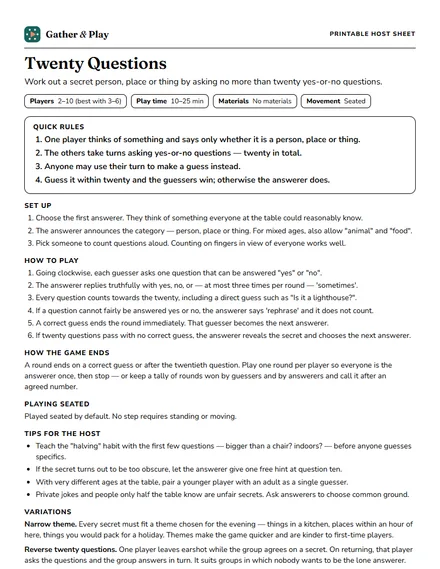
Twenty Questions — Printable host sheet
One page with the quick rules, set-up, and starter prompts — the same content as this page, laid out for print.
Where this game fits
We recommend Twenty Questions in these collections:
About this game
Traditional spoken parlor game; this explanation, the example and the starter ideas are original to Gather & Play.
Editorially checked for clarity and consistency. We do not claim group playtesting for this page. Editorial policy.