How to Play Would You Rather
Choose between two alternatives, defend your choice, and find out who at the table thinks the way you do.
- 2–30 players
- 10–30 min
- No materials
- Calm
Quick rules
- The host reads a question with two alternatives.
- Everyone picks one — there is no "both" or "neither".
- Go around the table and give a one-sentence reason.
- The person with the most unexpected reason reads the next question.
At a glance
- Players
- 2–30 players
- Best with
- 4–10
- Play time
- 10–30 min
- Prep
- No prep
- Materials
- No materials
- Energy
- Calm
- Noise
- Moderate
- Movement
- Seated
- Seated option
- Works seated
- Where
- Dinner table, Living room, Small space, Outdoors, Large room
Times are editorial estimates, not test results.
Reading: The host reads each question aloud. Players do not need to read anything.
Set up
What you need
Nothing. Voices only.
Nice to have:
- The Would You Rather prompt pack, on a phone or printed
- Choose a reader for the first question. The host view shuffles the prompt pack; without a phone, players can invent their own.
- Agree on one rule of tone before you start: questions stay clean and nobody has to justify a choice they would rather keep to themselves.
- Decide whether you are playing for conversation only, or keeping a light score using the "predict the room" variation.
How to play
- The reader asks a question in the form "Would you rather … or …?" and reads it twice.
- Everyone takes a few seconds to choose silently.
- On a count of three, all players show their choice at once — one finger for the first alternative, two for the second.
- Starting to the reader's left, each player gives a short reason. One sentence is enough.
- Players may question each other's logic, but the reader moves things along after a minute or two.
- The reader chooses the most surprising or entertaining reason. That player reads the next question.
Example round
Farah reads: "Would you rather always arrive twenty minutes early, or always arrive exactly on the minute — never earlier, never later?" On three, four people show one finger and two show two. Ines: "Early. I would get so much reading done in car parks." Gus: "Exactly on time — imagine never waiting for anything again." Lottie points out that "exactly on the minute" means Gus could never catch an earlier train, and the table spends a happy minute testing the edges of the rule. Farah awards the round to Ines for the car-park library, and Ines draws the next question.
How the game ends
Stop after a set number of questions — eight to ten suits a dinner table — or when the main course arrives. Would You Rather has no natural winner, so announce "two more questions" to give the game a clear finish rather than letting it fade out.
Group size: minimum, maximum and how to split
Would You Rather needs at least 2 players and works for up to about 30. It is at its best with 4–10 players.
Around a table, everyone can answer each question up to about ten players. Beyond that, use the "two sides of the room" version: the host reads a question and people move — or simply raise a left or right hand — to show their choice, then two or three volunteers per side explain. This works comfortably for 30 and keeps each question under two minutes.
Playing seated. Played seated by default. In the large-group version, replace walking to a side of the room with raising a left or right hand so nobody has to move.
Tips for the host
- The best questions make both alternatives slightly attractive or slightly awkward. Skip any that produce an instant unanimous answer.
- Invite quieter players to answer first on some rounds, so they are not always responding to louder voices.
- If a question lands badly, drop it without comment and draw another.
- For mixed ages, use the "everyday choices" category first; the imaginative dilemmas are more fun once people have warmed up.
Variations
Predict the room
Before the reveal, each player also predicts whether the majority will choose the first or second alternative. Score a point for each correct prediction. It turns the game into a gentle test of how well the group knows each other.
Convince me
After the reveal, the minority side gets thirty seconds to persuade the majority. Anyone who genuinely changes their mind switches sides. The minority scores a point for every convert.
Prompts for this game
120 original, clean Would You Rather questions in three groups. Every question offers two complete alternatives.
Everyday choices
- always arrive twenty minutes earlyoralways arrive exactly on the minute
- give up coffee and tea for a yearorgive up desserts for a year
- have a home that is always tidy but never quite cleanoralways clean but never quite tidy
- cook dinner every nightorwash up every night
- live without musicorlive without films and television
- have a long weekend every weekorhave three months off once a year
Printable host sheet
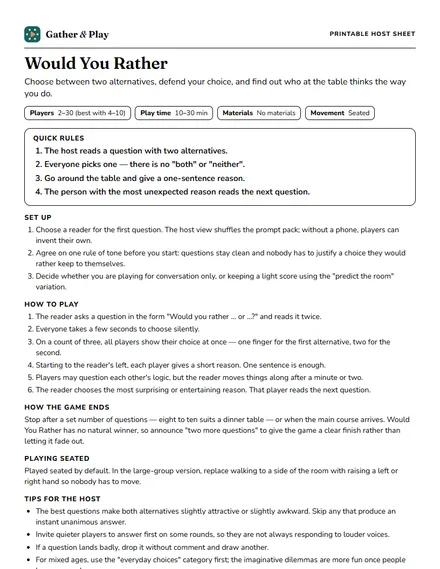
Would You Rather — Printable host sheet
One page with the quick rules, set-up, and starter prompts — the same content as this page, laid out for print.
Where this game fits
We recommend Would You Rather in these collections:
- Dinner Party Games: 8 Table Games Nobody Has to Leave Their Seat For
- Indoor Party Games for Adults: 9 Picks for Any Living Room
- Family Reunion Games: 10 Ideas That Work for Every Generation
- Birthday Party Games for Adults: 9 Ideas Guests Actually Join In
- Party Games Without Props: 12 Games You Can Play With Nothing
- Indoor Games for Large Groups: 8 That Still Work With 30 People
- Party Games for Seniors: 10 Seated, Sociable Games for Older Adults
- Icebreaker Games for Adults: 8 Low-Pressure Ways to Start
- Halloween Party Games for Adults: 8 Friendly-Spooky Ideas
- Christmas Party Games for Adults: 8 Festive Ideas for Mixed Company
About this game
Traditional conversation game with no single author; this explanation, the example and all questions are original to Gather & Play.
Editorially checked for clarity and consistency. We do not claim group playtesting for this page. Editorial policy.