How to Play Shared Connections
In a small group, find three things you all have in common that nobody could tell just by looking at you.
- 4–40 players
- 10–20 min
- No materials
- Lively
Quick rules
- Form groups of three or four, ideally with people you know least.
- You have four minutes to find three things you all share.
- Nothing visible counts — not clothes, not "we are all at this party".
- Each group shares its most surprising connection with the room.
At a glance
- Players
- 4–40 players
- Best with
- 8–24
- Play time
- 10–20 min
- Prep
- 1 min prep
- Materials
- No materials
- Energy
- Lively
- Noise
- Moderate
- Movement
- Standing optional
- Seated option
- Seated variation
- Where
- Living room, Large room, Outdoors, Dinner table, Small space
Times are editorial estimates, not test results.
Reading: None. The host explains the task aloud.
Set up
What you need
Nothing. Voices only.
Nice to have:
- A phone timer
- Conversation nudges from the host view
- Ask people to form groups of three or four. Suggest mixing — different families, different generations, different friendship circles.
- Explain what counts: a connection must be true of every person in the group, and it must not be visible or obvious. 'We all have hair' does not count. 'We have all broken the same bone' does.
- Give two or three examples of the kinds of topic that tend to work — food, places, first jobs, small habits.
- Set a timer for four minutes.
How to play
- When the timer starts, each group talks freely, looking for things all its members share.
- A connection only counts if it is true of everyone in the group. Two out of three is not enough.
- A connection must not be something visible, nor something true of everybody in the room.
- Groups aim for three connections. A group that reaches three early should look for a fourth that is more unusual.
- When the timer ends, each group chooses its single most surprising connection.
- Going round the room, one speaker per group announces their connection in a sentence.
- For a second round, form new groups, with nobody from your first group if possible.
Example round
Halima, Stefan and Old Pete form a group at a family reunion — an aunt by marriage, a teenager's boyfriend and a great-uncle. They start with food. All like spicy food? Pete does not. Any shared places? Stefan has never left the country. Then Halima mentions that she learned to swim embarrassingly late, at nineteen. Stefan was fourteen. Pete announces that he was thirty-one and that it was in a canal. One connection. They also discover that all three have been locked out of their own homes in the past year, and that none of them can whistle. At the share-back they choose the canal.
How the game ends
The game ends after the share-back. Two rounds with different groups are plenty — the purpose is to give people something to talk about for the rest of the event, so stop while the room is still noisy. There is no winner, though the host can ask for applause for the most unexpected connection.
Group size: minimum, maximum and how to split
Shared Connections needs at least 4 players and works for up to about 40. It is at its best with 8–24 players.
This is one of the few games that gets better with numbers. Groups of three or four are right at any size — a room of forty is simply ten groups. With more than about twenty-four people, hear only one connection from each group in the share-back, or the reporting takes longer than the game. With an odd number left over, make one group of five rather than a pair.
Playing seated. Form groups from people who are already sitting near each other, instead of asking everyone to mingle. When groups are remixed for the second round, only those who are comfortable moving need to change seats.
Tips for the host
- Walk round during the four minutes. A group that is stuck usually needs only a single topic — suggest "worst holiday" or "first job".
- State plainly that nobody has to share anything they would rather not. Trivial connections are the best kind.
- With several generations in the room, ask each group to include at least two age groups.
- Keep the share-back brisk. One sentence per group — the stories can continue over food.
Variations
Uncommon ground
In addition to three shared things, each group looks for one thing that is true of exactly one member and nobody else in the group. It gives every person a moment of being interesting.
Connection chain
After the share-back, each group tries to find one link with the group next to it, and so on round the room, until there is a chain running through the whole party. It makes a good closing moment for a large reunion.
Prompts for this game
Topics to suggest when a group is stuck. None needs a personal disclosure.
Conversation nudges
- Foods you all refuse to eat
- A chore you all secretly enjoy
- Something none of you has ever done
- First jobs
- Things you were all afraid of as children
- A place you have all been
- Something you have all lost and never found
- Skills you all lack
- A habit you all share in the morning
- Something you all learned later than most people
- Weather you all love or all dislike
- Something you have all broken
- An item you all own and never use
- A food you all eat in the same odd way
Printable host sheet
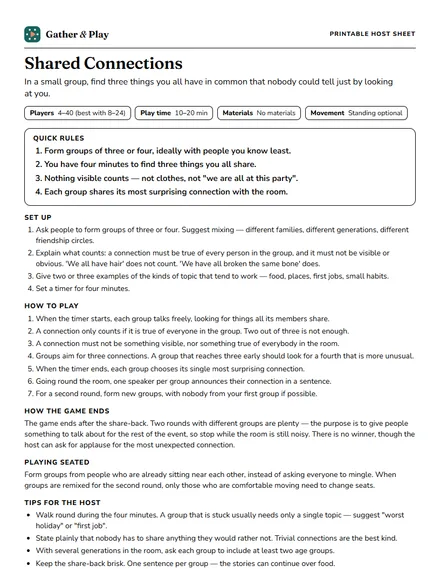
Shared Connections — Printable host sheet
One page with the quick rules, set-up, and starter prompts — the same content as this page, laid out for print.
Where this game fits
We recommend Shared Connections in these collections:
About this game
A common "things in common" icebreaker format; this rule set, the example and the conversation nudges are original to Gather & Play.
Editorially checked for clarity and consistency. We do not claim group playtesting for this page. Editorial policy.