Indoor Games for Large Groups: 8 That Still Work With 30 People
A game designed for six does not automatically work for thirty. Past about fifteen people, sound, sightlines and waiting time change everything. These games either scale naturally or come with exact instructions for splitting the room.
The short answer
For fifteen to forty people indoors, use games built on small groups or whole-room voting. Shared Connections works at any size, hands-up Would You Rather involves everyone at once, and Team Object Pitch and Reverse Charades scale by adding teams. Above twenty-four people, run team games as two parallel games.
The games we recommend
In a small group, find three things you all have in common that nobody could tell just by looking at you.
Why it fits: Forty people are simply ten groups of four. It is the one game here that needs no adaptation at any size.
- 4–40 players
- 10–20 min
- No materials
- Standing optional
- Seated variation
Choose between two alternatives, defend your choice, and find out who at the table thinks the way you do.
Why it fits: The whole room answers every question by raising a hand, so nobody waits for a turn.
- 2–30 players
- 10–30 min
- No materials
- Seated
- Works seated
As a team, take an ordinary object from the room and pitch it to the party as a brilliant new invention with a completely different purpose.
Why it fits: Up to six teams can pitch to the room in turn, and the audience vote keeps everyone involved.
- 4–30 players
- 20–40 min
- No materials
- Standing optional
- Seated variation
The whole team acts out a prompt together while a single teammate tries to guess it.
Why it fits: Four to six people act at once, which uses up players quickly and gives the audience more to watch.
- 6–24 players
- 15–35 min
- No materials
- Standing and moving
- Seated variation
Act out a word or phrase without speaking so your team can guess it before the timer runs out.
Why it fits: With three or four teams and strict timing it works for twenty; beyond that, run two games side by side.
- 4–20 players
- 20–45 min
- No materials
- Standing and moving
- Seated variation
Take turns naming things that fit a category, without repeating an answer or hesitating too long.
Why it fits: Circles of six play the same category at the same moment, and each circle's winner joins a final.
- 3–12 players
- 10–25 min
- No materials
- Seated
- Works seated
Tell a story together, one word per person, and try to bring it to an ending that makes sense.
Why it fits: Every circle gets the same title, and comparing the finished stories is the payoff.
- 3–12 players
- 5–20 min
- No materials
- Seated
- Works seated
Share three statements about yourself — two true, one invented — and see whether the group can spot the lie.
Why it fits: Played in clusters of five or six, it turns one unmanageable crowd into several good conversations.
- 3–12 players
- 10–30 min
- No materials
- Seated
- Works seated
Compare the games at a glance
| Game | Players | Play time | Prep | Materials | Movement | Seated option | Energy |
|---|---|---|---|---|---|---|---|
| Shared Connections | 4–40 | 10–20 min | 1 min prep | No materials | Standing optional | Yes | Lively |
| Would You Rather | 2–30 | 10–30 min | No prep | No materials | Seated | Yes | Calm |
| Team Object Pitch | 4–30 | 20–40 min | 2 min prep | No materials | Standing optional | Yes | High energy |
| Reverse Charades | 6–24 | 15–35 min | 3 min prep | No materials | Standing and moving | Yes | High energy |
| Charades | 4–20 | 20–45 min | 3 min prep | No materials | Standing and moving | Yes | High energy |
| Categories | 3–12 | 10–25 min | No prep | No materials | Seated | Yes | Lively |
| One-Word Story | 3–12 | 5–20 min | No prep | No materials | Seated | Yes | Lively |
| Two Truths and a Lie | 3–12 | 10–30 min | No prep | No materials | Seated | Yes | Calm |
Times are editorial estimates, not test results.
One hour for twenty to thirty people
Designed for a hall, an office common room or a large living room. You will need one person with a clear voice, and it helps to have a second host for the parallel games.
- Step 1 · 8 minutes
Would You Rather
Hands-up version, six questions. Gets the whole room responding together.
- Step 2 · 15 minutes
Shared Connections
Groups of four. Hear one connection from each group.
- Step 3 · 25 minutes
Team Object Pitch
Keep the same groups, merged into teams of four. 45-second pitches.
- Step 4 · 12 minutes
One-Word Story
Circles of six to eight with the same title; one narrator per circle retells it.
About 60 minutes in total. Times are editorial estimates, not test results.
Why large groups need different games
Three things break when a group grows.
Waiting time. In a circle of six, your turn comes round every minute. In a circle of thirty, it comes round every five, and most of the room has stopped listening by then. Any game in which “everyone takes a turn” needs to be divided.
Sound. Thirty people in a room are loud even when they are trying to be quiet. Games that rely on hearing one soft-spoken player from across the room fail. Games that happen within small clusters, or that use big visible signals such as raised hands, succeed.
Sightlines. An acting game needs an audience that can see. Beyond about twenty spectators, people at the back are watching the backs of heads.
So we chose games in three structural families: games played in small groups simultaneously, games in which the whole room responds at once, and team games with a clear rule for adding more teams or running in parallel.
Exactly how to split a large group
Every rules page on this site states a minimum and a practical maximum. This table summarises the splits for this collection.
| Game | Up to 15 | 16–24 | 25–40 |
|---|---|---|---|
| Shared Connections | Groups of 3–4 | Groups of 3–4 | Groups of 4; one connection per group in share-back |
| Would You Rather | Hands or sides of the room | Hands up | Hands up; two volunteers per side explain |
| Team Object Pitch | 3–4 teams | 5–6 teams of 4 | Two heats, winners to a final |
| Reverse Charades | 2–3 teams of 5 | 4 teams, one stage | Two stages, two hosts |
| Charades | 2–3 teams | 3–4 teams | Two separate games |
| Categories | Two circles | Circles of 6 | Circles of 6–7, winners’ final |
| One-Word Story | Two circles | Circles of 6–8 | Circles of 8, same title |
| Two Truths and a Lie | Two clusters | Clusters of 5–6 | Clusters of 6; each nominates one story |
The fastest way to form groups is to count off. For groups of four in a room of twenty-eight, count round the room from one to seven; all the ones are a group, all the twos, and so on. It takes a minute and automatically separates people who arrived together.
Running the room
Hosting thirty people is a different skill from hosting eight.
- Get attention with a signal, not a shout. Raise a hand and ask everyone who sees it to raise theirs and stop talking. It works within ten seconds and saves your voice.
- Explain once, then demonstrate. Play one example round with a volunteer group in front of everyone before the whole room starts.
- Give time warnings. “One minute left” lets groups finish their thought instead of being cut off.
- Recruit a second host for any parallel game. Each game needs its own timekeeper.
- Shorten everything. A ninety-second charades turn becomes sixty. A one-minute pitch becomes forty-five seconds. Long turns multiply badly.
- Plan the transitions. Moving thirty people into new groups takes two or three minutes. Keep the same groups for consecutive games where you can.
For a detailed look at seating, walkways and noise in a crowded room, see our guide to playing in a small space — its advice on large-group limits applies to any room that feels full.
Games we do not recommend for large groups
It is just as useful to know what to avoid. Twenty Questions, Guess the Rule, Conversation Ladder and Secret Word Detective all depend on one conversation that everyone can follow. They are excellent for a table of eight and frustrating for a room of thirty. If you love one of them, run it at separate tables, each with its own host — or save it for a night with a small group.
Common mistakes with large groups
- One circle for everyone. It is the natural instinct and nearly always wrong above twelve people.
- Rules explained to a noisy room. Get silence first. Anything said over chatter must be said again.
- Elimination games. Half the room is out, bored and talking within minutes. Use points.
- Too many teams presenting. More than six presentations in a row tests anyone’s patience. Use heats.
- No plan for people who would rather watch. In a large group there will be some. Make spectating a comfortable, visible option.
Quick answers
What indoor games can you play with a large group of adults?
Shared Connections, hands-up Would You Rather, Team Object Pitch, Reverse Charades and multi-team Charades all work indoors for fifteen to forty adults. They need little or no equipment, and each has a clear rule for splitting the room into small groups or parallel games.
What is a good game for 20 people?
For twenty people, play Shared Connections in five groups of four, then merge into five teams for Team Object Pitch. Every person is active for most of the time, the room needs no equipment, and the two games together fill about forty minutes.
How do you play games with 30 or more people?
Split the room. Use games that run in groups of three to six at the same time, or games in which everybody answers together by raising a hand. For team games, run two parallel games with a host each instead of making one enormous game.
What large-group games need no equipment?
Shared Connections, Would You Rather, Categories, One-Word Story and Two Truths and a Lie need nothing at all. See our full list of party games without props, and our family reunion games for mixed-age crowds.
Prompts and printables for this occasion
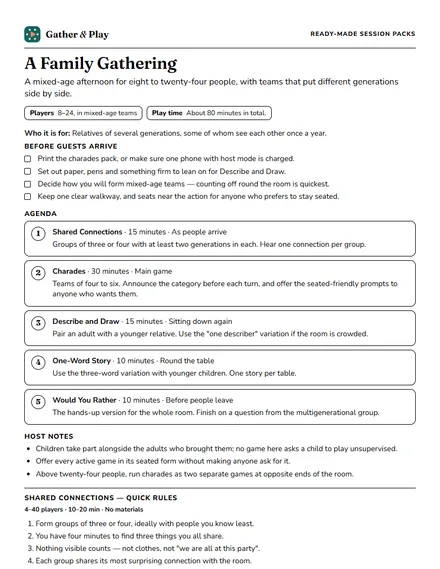
A Family Gathering
A mixed-age afternoon for eight to twenty-four people, with teams that put different generations side by side.