How to Play Two-Word Clues
Help your team guess a secret word by giving clues that are exactly two words long — no more, no fewer.
- 4–16 players
- 15–30 min
- No materials
- Lively
Quick rules
- Two teams. One player per turn is the clue-giver.
- The clue-giver sees a secret word and gives a two-word clue.
- Teammates get one guess per clue.
- Score a point for each word guessed within 90 seconds. Fewer clues, more words.
At a glance
- Players
- 4–16 players
- Best with
- 6–10
- Play time
- 15–30 min
- Prep
- 2 min prep
- Materials
- No materials
- Energy
- Lively
- Noise
- Moderate
- Movement
- Seated
- Seated option
- Works seated
- Where
- Living room, Dinner table, Small space, Outdoors, Large room
Times are editorial estimates, not test results.
Reading: The clue-giver reads one target word silently, or has it whispered by a player on the other team.
Set up
What you need
Nothing. Voices only.
Nice to have:
- A phone timer
- Target words from the host view
- Split into two or more teams and seat teammates where they can hear each other.
- Decide how target words will be delivered — the host view on a phone passed to the clue-giver, or an opponent whispering a word.
- Set a 90-second timer for the turn.
- Explain what is forbidden: no part of the target word, no rhyming hints, no gestures, and no 'sounds like'.
How to play
- The first team's clue-giver looks at a target word, keeping it hidden from their team.
- They give a clue of exactly two words — for example, "morning drink" for the word "coffee".
- The team confers briefly and gives one guess.
- If the guess is wrong, the clue-giver offers a new two-word clue for the same word. Earlier clues cannot be repeated.
- If the guess is right, the team scores a point and the clue-giver takes a new word at once.
- The clue-giver may pass on a word. A passed word is read out afterwards and scores nothing.
- If a clue breaks a rule — one word, three words, or part of the target — the other team calls it and the word is thrown out.
- When the timer ends, play passes to the next team, with a new clue-giver.
Example round
Imani is giving clues for her team; the word is "lighthouse". "Coastal tower." Her team confers. "Castle?" No. "Warning beam." "Lighthouse!" Point, and a new word: "pillow". "Head rest." "Pillow!" New word: "queue". Imani thinks. "Patient line." "Fishing?" "Supermarket checkout." Laughter — "Queue!" Three points and eleven seconds left. The next word is "thermometer"; she begins "Fever checker —" and the timer sounds. No point for that one, and the other team's clue-giver steps up.
How the game ends
Play until everyone has been the clue-giver once, then compare totals. If teams have different numbers of players, give each team the same number of turns and let someone on the smaller team give clues twice.
Group size: minimum, maximum and how to split
Two-Word Clues needs at least 4 players and works for up to about 16. It is at its best with 6–10 players.
Use two teams up to about ten players, and three or four teams up to sixteen, so that nobody waits more than a couple of minutes for their side to play. Above sixteen, split into two separate games; the clue-giving is quiet enough for two games to share a room.
Playing seated. Played seated by default. Clue-givers stay in their seats; no step requires standing.
Tips for the host
- Hyphenated words count as one word only if the whole group agrees beforehand. Decide before the first turn.
- Encourage teams to guess quickly. A wrong guess costs only seconds, while silence costs more.
- If a clue-giver is struggling, remind them that passing is free and that some words are simply harder.
- With mixed ages, let the younger clue-givers use three-word clues. Nobody minds.
Variations
One-word clues
Clues shrink to a single word, and the team gets up to three guesses per word. It is harder and quieter — a good second half once everyone understands the rhythm.
Shared word
Both teams' clue-givers see the same word and take turns giving one two-word clue each, with their own team guessing after each clue. The team that guesses first scores. Each clue helps both teams, which makes giving a good clue a risk.
Prompts for this game
Familiar target words, in two levels of difficulty.
Straightforward
- coffee
- pillow
- lighthouse
- queue
- birthday
- umbrella
- library
- breakfast
- passport
- sandcastle
Trickier
- thermometer
- echo
- shadow
- compromise
- nostalgia
- horizon
- appetite
- souvenir
- rumour
- patience
Printable host sheet
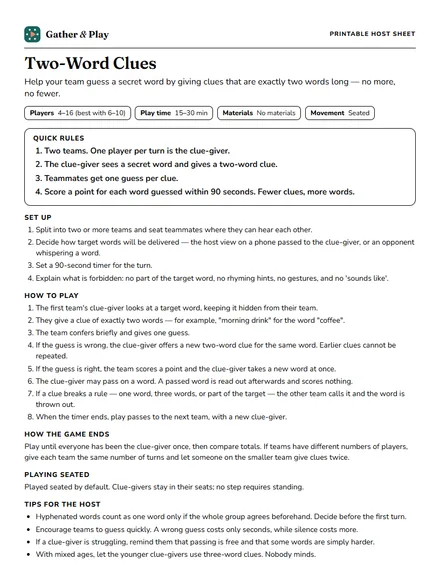
Two-Word Clues — Printable host sheet
One page with the quick rules, set-up, and starter prompts — the same content as this page, laid out for print.
Where this game fits
We recommend Two-Word Clues in these collections:
- Indoor Party Games for Adults: 9 Picks for Any Living Room
- Birthday Party Games for Adults: 9 Ideas Guests Actually Join In
- Party Games for Small Groups: 10 Games for 3 to 8 Players
- Party Games for Seniors: 10 Seated, Sociable Games for Older Adults
- Halloween Party Games for Adults: 8 Friendly-Spooky Ideas
- Christmas Party Games for Adults: 8 Festive Ideas for Mixed Company
About this game
Belongs to the long tradition of restricted-clue word-guessing games; this rule set, the example and the word list are original to Gather & Play.
Editorially checked for clarity and consistency. We do not claim group playtesting for this page. Editorial policy.