How to Play Two Truths and a Lie
Share three statements about yourself — two true, one invented — and see whether the group can spot the lie.
- 3–12 players
- 10–30 min
- No materials
- Calm
Quick rules
- Each player thinks of two true statements and one believable lie about themselves.
- One player says all three in any order.
- The group asks a few questions, then votes on which is the lie.
- The speaker reveals the answer and tells the story behind a truth.
At a glance
- Players
- 3–12 players
- Best with
- 4–8
- Play time
- 10–30 min
- Prep
- No prep
- Materials
- No materials
- Energy
- Calm
- Noise
- Quiet
- Movement
- Seated
- Seated option
- Works seated
- Where
- Dinner table, Living room, Small space, Outdoors, Large room
Times are editorial estimates, not test results.
Reading: None. Everything is spoken.
Set up
What you need
Nothing. Voices only.
- Seat everyone where they can see each other — around a table or in a loose circle.
- Give the group one quiet minute to think. Good statements are specific, harmless and a little surprising.
- Set the tone out loud: statements should be things you are happy for everyone here to know. Nobody needs to share anything private.
- The host goes first to model the kind of statement that works.
How to play
- The first player says three statements about themselves in any order, in the same even tone.
- The group may ask up to three follow-up questions. The speaker answers as though all three statements were true.
- On a count of three, everyone votes by holding up one, two or three fingers for the statement they believe is the lie.
- The speaker reveals the lie.
- The speaker picks one of the true statements and tells the short story behind it.
- Optional scoring: the speaker earns one point for every person they fooled, and each correct guesser earns one point.
- Play passes to the left until everyone has had a turn.
Example round
Tomás goes first. "One: I once drove four hours to buy a second-hand accordion. Two: I have never eaten a hard-boiled egg. Three: my first job was painting lines on a tennis court." Aiko asks what colour the accordion was — "Red, with one sticky key." Ben asks whether the egg thing is a dislike or just chance — "Pure chance, it has simply never come up." On three, four people hold up two fingers and one holds up three. Tomás grins. "The lie is the tennis court. My first job was in a bakery." Then he tells the accordion story, which involves a ferry and a very patient seller.
How the game ends
The game ends when everyone has had one turn. With a small group that is enjoying itself, play a second round with a theme — "travel", "school days" or "food" — and stop there. If you are scoring, the highest total after the final turn wins.
Group size: minimum, maximum and how to split
Two Truths and a Lie needs at least 3 players and works for up to about 12. It is at its best with 4–8 players.
A full turn takes two to three minutes per person, so twelve players already means half an hour. For bigger gatherings, split into tables or clusters of 5–6 and let each cluster play its own game. At the end, ask each cluster to nominate its most surprising truth to share with the whole room.
Playing seated. The game is played seated by default. Nothing in any step requires standing or moving.
Tips for the host
- Ordinary truths work better than dramatic ones. "I alphabetise my spices" is harder to judge than "I met a celebrity".
- Let anyone pass or go later. Some people need to hear two or three turns before they have an idea.
- If someone is stuck, suggest a formula — one truth about food, one about a place, and a lie about a skill.
- Keep the follow-up questions short. They are there to make the vote fun, not to interrogate anyone.
Variations
Themed rounds
Every statement must fit one announced theme — a job you have had, a place you have been, a food opinion you hold. Themes make it easier to think of statements and keep the game light among people who have only just met.
Two Truths and a Wish
Replace the lie with something you wish were true. It removes the "deception" element entirely, which some groups prefer, and the reveal often starts a better conversation than a lie does.
Prompts for this game
60 original example sets. Each shows two "truth-shaped" statements and one sample lie, with a note on adapting it. They are patterns to rewrite with your own real details — never statements to present as your life.
Everyday habits
-
- I set three alarms every morning.
- I have never owned an umbrella.
- I iron my socks.
Sample lie: “I iron my socks.”
How to adapt it: Swap in your real morning routine; keep the lie just as mundane. -
- I alphabetise my bookshelf.
- I talk to my houseplants.
- I have kept every cinema ticket since I was twelve.
Sample lie: “I have kept every cinema ticket since I was twelve.”
How to adapt it: Use two real habits and one collection you never started. -
- I always sit in the same seat on the bus.
- I have never finished a crossword.
- I write my shopping lists in rhyme.
Sample lie: “I write my shopping lists in rhyme.”
How to adapt it: The lie works because it is odd but harmless — invent your own. -
- I drink my tea cold on purpose.
- I check the weather four times a day.
- I have named my car.
Sample lie: “I have named my car.”
How to adapt it: Replace with real quirks about drinks, weather or belongings. -
- I can only sleep with socks on.
- I have used the same pen for six years.
- I fold my laundry the moment it is dry.
Sample lie: “I fold my laundry the moment it is dry.”
How to adapt it: Choose habits your friends would half believe. -
- I walk the same route every evening.
- I always read the last page of a book first.
- I have never hit the snooze button.
Sample lie: “I have never hit the snooze button.”
How to adapt it: A virtuous-sounding lie is hard to spot.
Printable host sheet
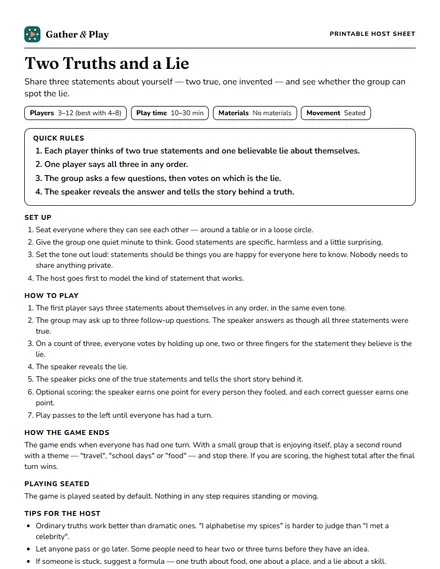
Two Truths and a Lie — Printable host sheet
One page with the quick rules, set-up, and starter prompts — the same content as this page, laid out for print.
Where this game fits
We recommend Two Truths and a Lie in these collections:
- Dinner Party Games: 8 Table Games Nobody Has to Leave Their Seat For
- Family Reunion Games: 10 Ideas That Work for Every Generation
- Birthday Party Games for Adults: 9 Ideas Guests Actually Join In
- Party Games Without Props: 12 Games You Can Play With Nothing
- Indoor Games for Large Groups: 8 That Still Work With 30 People
- Party Games for Seniors: 10 Seated, Sociable Games for Older Adults
- Icebreaker Games for Adults: 8 Low-Pressure Ways to Start
About this game
Traditional icebreaker with no single author; this explanation, the example and the example statement sets are original to Gather & Play.
Editorially checked for clarity and consistency. We do not claim group playtesting for this page. Editorial policy.