Indoor Party Games for Adults: 9 Picks for Any Living Room
Games for an ordinary living room — a sofa, a few extra chairs, neighbours on the other side of the wall. We tell you how much floor, noise and preparation each one really needs.
The short answer
The best indoor party games for adults need little space and almost no equipment. Open with Two-Word Clues to form teams, move to Charades or Reverse Charades while energy is high, switch to Guess the Rule for a calmer round, and close with Story Remix. Together they fill about ninety minutes.
The games we recommend
Act out a word or phrase without speaking so your team can guess it before the timer runs out.
Why it fits: The classic for a reason — it turns a living room into a stage, and our pack tags every prompt that can be acted from a chair.
- 4–20 players
- 20–45 min
- No materials
- Standing and moving
- Seated variation
Help your team guess a secret word by giving clues that are exactly two words long — no more, no fewer.
Why it fits: A team game that is fully seated and fairly quiet, so it suits small rooms, late evenings and guests who dislike performing.
- 4–16 players
- 15–30 min
- No materials
- Seated
- Works seated
The whole team acts out a prompt together while a single teammate tries to guess it.
Why it fits: The whole team acts while one person guesses, which removes the spotlight from any single nervous guest.
- 6–24 players
- 15–35 min
- No materials
- Standing and moving
- Seated variation
One player questions the group and tries to discover the secret rule that everyone else is following when they answer.
Why it fits: It needs no materials and no floor space, and it gives the room a rest between two louder games.
- 4–12 players
- 15–30 min
- No materials
- Seated
- Works seated
Retell a simple, everyday story in a surprising style — as a weather forecast, a sports commentary, a bedtime story — and let the group guess the style.
Why it fits: One minute of storytelling per player, from a seat, with the group guessing the style. It is performance without the pressure of acting.
- 3–10 players
- 15–30 min
- No materials
- Seated
- Works seated
As a team, take an ordinary object from the room and pitch it to the party as a brilliant new invention with a completely different purpose.
Why it fits: Teams use whatever is already in the room, so the setting itself becomes the game. It is the loudest laugh on this list.
- 4–30 players
- 20–40 min
- No materials
- Standing optional
- Seated variation
Describe a simple picture using words alone so that a partner, who cannot see it, can draw it as accurately as possible.
Why it fits: A quiet, paired game for the middle of the evening, needing only paper and a pen for each pair.
- 2–16 players
- 10–25 min
- Paper and pen
- Seated
- Works seated
Hear four things, decide which one does not belong, and convince the table that your reason is the best one.
Why it fits: A sit-down debate that needs nothing at all and works just as well for five people as for twelve.
- 3–12 players
- 10–25 min
- No materials
- Seated
- Works seated
Choose between two alternatives, defend your choice, and find out who at the table thinks the way you do.
Why it fits: The safest possible opener while guests arrive, and an easy wind-down when the evening is ending.
- 2–30 players
- 10–30 min
- No materials
- Seated
- Works seated
Compare the games at a glance
| Game | Players | Play time | Prep | Materials | Movement | Seated option | Energy |
|---|---|---|---|---|---|---|---|
| Charades | 4–20 | 20–45 min | 3 min prep | No materials | Standing and moving | Yes | High energy |
| Two-Word Clues | 4–16 | 15–30 min | 2 min prep | No materials | Seated | Yes | Lively |
| Reverse Charades | 6–24 | 15–35 min | 3 min prep | No materials | Standing and moving | Yes | High energy |
| Guess the Rule | 4–12 | 15–30 min | No prep | No materials | Seated | Yes | Calm |
| Story Remix | 3–10 | 15–30 min | 1 min prep | No materials | Seated | Yes | Lively |
| Team Object Pitch | 4–30 | 20–40 min | 2 min prep | No materials | Standing optional | Yes | High energy |
| Describe and Draw | 2–16 | 10–25 min | 5 min prep | Paper and pen | Seated | Yes | Calm |
| Odd One Out | 3–12 | 10–25 min | No prep | No materials | Seated | Yes | Calm |
| Would You Rather | 2–30 | 10–30 min | No prep | No materials | Seated | Yes | Calm |
Times are editorial estimates, not test results.
A ninety-minute living room running order
Written for eight to twelve adults. It alternates loud and quiet games so that the room — and the neighbours — get regular breaks.
- Step 1 · 10 minutes
Would You Rather
As guests arrive. No teams, no explanation, easy to join halfway.
- Step 2 · 25 minutes
Two-Word Clues
Form two teams. Keep these teams for the rest of the night.
- Step 3 · 20 minutes
Reverse Charades
The loud peak of the evening. Clear the stage area first.
- Step 4 · 15 minutes
Guess the Rule
Everyone sits down again. Start with a gesture rule.
- Step 5 · 20 minutes
Story Remix
Volunteers first. Stop while people are still asking for a turn.
About 90 minutes in total. Times are editorial estimates, not test results.
How we chose these indoor games
“Indoor” sounds like a simple requirement, but it rules out more than you might expect. A living room has furniture that cannot move far, a floor that may be shared with a downstairs neighbour, and a ceiling light at exactly head height. We chose games that respect those limits:
- A small footprint. No game here needs more open floor than a single clear patch of about two metres by two — the space in front of a sofa.
- Nothing thrown, nothing breakable. There are no balls, no balloons and no running. The only “equipment” is paper and a pen in one game.
- Controllable noise. Each game is labelled quiet, moderate or loud, and for every loud game there is a quiet alternative on the same list.
- A seated version. Every pick can be played from a chair, either by design or with the variation described on its rules page.
If you are hosting in a studio flat or a crowded room, our guide to playing in a small space has more on seating, walkways and noise.
Loud games and quiet games
The single most useful thing a host can do indoors is alternate energy levels. Two loud games in a row exhaust people; two quiet ones can let the evening sag.
Loud and active: Charades, Reverse Charades and Team Object Pitch. These are the games people remember. Schedule one in the first half of the evening and, if the group wants it, one more later.
Lively but seated: Two-Word Clues and Story Remix. Both involve teams or an audience, yet nobody leaves their seat and voices stay at conversation level.
Quiet and thoughtful: Guess the Rule, Describe and Draw, Odd One Out and Would You Rather. Use these as openers, as breaks, and for the last half hour.
If you live in a flat with thin walls, build the evening from the second and third groups only. It will still be a good night.
Setting up the room
A few minutes of preparation makes every game on this page run better:
- Decide where the “stage” is before guests arrive. The best spot has the audience’s backs to the main light, so the actor’s face is lit.
- Move the coffee table to the side, or out of the room. It is the most common obstacle in acting games.
- Give drinks a home that is not the floor and not the arm of the sofa.
- Put chairs in an arc, not in rows. Everyone should be able to see everyone else’s face.
- Keep one walkway clear to the door and the bathroom, so nobody has to cross the stage.
Our guide on how to host a game night covers invitations, breaks and a complete worked plan.
Prompts you will need
Three of these games need prompts, and all of them are free on this site. Charades ideas and words has 180 prompts in six categories, each tagged by difficulty and by whether it can be acted seated. Reverse Charades uses the same pack plus sixteen team scenes. For Would You Rather, the question pack has 120 clean questions for adults.
You can read prompts straight from a phone using host mode — each game page has an “Open host mode” button that shuffles the deck without repeats — or print the cards on Letter or A4 paper.
Common mistakes with indoor party games
- Starting with the loudest game. People need ten minutes to warm up. Open with something seated.
- Unbalanced teams. Mix confident and quiet players deliberately; never let teams form “naturally” into friends versus strangers.
- One long game. Forty-five minutes of anything is too much. Change games every twenty to twenty-five minutes.
- Forgetting people who would rather watch. Give spectators a job — timekeeper, judge, score — and never push anyone onto the stage.
- No end time. Announce the final game before it starts.
Quick answers
What are good indoor party games for adults with no equipment?
Guess the Rule, Odd One Out, Would You Rather, Story Remix and Two-Word Clues need nothing but voices; the host can read prompts from a single phone. Charades also needs no equipment if the opposing team whispers the prompts. See all twelve voice-only options in our games without props collection.
How many people do you need for indoor party games?
Most games on this page work from four players. Team games such as Charades and Two-Word Clues are best with six to twelve, so each team has at least three people. For three to eight players, see party games for small groups; above twelve, see indoor games for large groups.
What indoor games work in a small living room?
Choose seated games: Two-Word Clues, Guess the Rule, Odd One Out, Story Remix and Would You Rather all work with people on sofas and floor cushions. Charades works too if you use the seated-friendly prompts and act from a chair.
How long should an indoor game night last?
Around ninety minutes of actual play is plenty for most groups, spread over two to three hours with food and breaks. Plan four or five short games rather than one long one, and tell guests in advance roughly when the evening will end.
Prompts and printables for this occasion
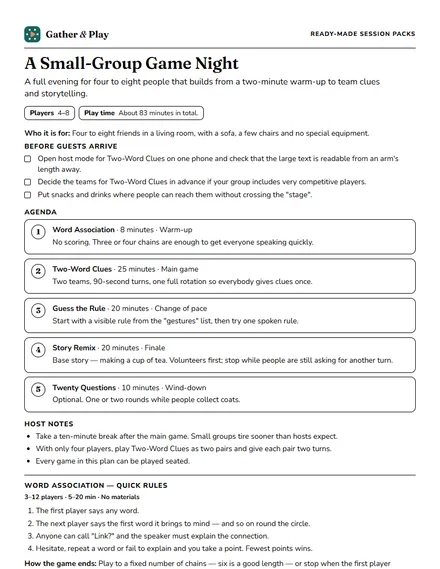
A Small-Group Game Night
A full evening for four to eight people that builds from a two-minute warm-up to team clues and storytelling.