How to Play Reverse Charades
The whole team acts out a prompt together while a single teammate tries to guess it.
- 6–24 players
- 15–35 min
- No materials
- High energy
Quick rules
- Teams of four to six. One teammate is the guesser and faces the others.
- The rest of the team sees the prompt and acts it out together, silently.
- Score a point for every prompt guessed inside 60 seconds.
- Rotate the guesser every turn.
At a glance
- Players
- 6–24 players
- Best with
- 8–16
- Play time
- 15–35 min
- Prep
- 3 min prep
- Materials
- No materials
- Energy
- High energy
- Noise
- Loud
- Movement
- Standing and moving
- Seated option
- Seated variation
- Where
- Living room, Large room, Outdoors
Times are editorial estimates, not test results.
Reading: The acting team reads one short prompt together; the guesser reads nothing.
Set up
What you need
Nothing. Voices only.
Nice to have:
- A phone timer
- Printed charades cards
- Make teams of 4–6 and clear enough floor space for one team to stand side by side.
- Choose the first guesser on each team. The guesser stands or sits with their back to the host.
- Decide how prompts are shown — the host holds up a phone in host view behind the guesser, or shows a printed card.
- Set a 60-second timer for the turn. Teams try to get through as many prompts as they can.
How to play
- The host shows the acting team a prompt from behind the guesser, so the guesser cannot see it.
- The team acts it out at the same time. They may not talk, make sound effects, or plan aloud — any coordination has to happen through acting.
- The guesser calls out guesses. When they get it right, the host shows the next prompt immediately.
- The team may pass on a prompt by crossing their arms; a pass costs nothing but the lost seconds.
- When the timer ends, the team scores one point per correct guess.
- The next team plays. On each team's following turn, a different person becomes the guesser.
Example round
Dele is guessing for his team of five. Behind him the host shows "assembling flat-pack furniture". There is a half-second of silent panic, then Mina kneels and squints at an invisible instruction sheet, Jo holds up an invisible plank, and two others hammer in different places. "Building a shed? Camping?" Mina turns the imaginary sheet upside down and scratches her head. "Instructions... furniture! Flat-pack furniture!" Next prompt — "a slow-motion replay" — and the whole team instantly begins to move at a tenth of normal speed. Dele gets it in four seconds. Two points when the timer sounds.
How the game ends
Play until every player on every team has been the guesser once. The highest total wins. With uneven teams, stop when the smallest team has completed its rotation.
Group size: minimum, maximum and how to split
Reverse Charades needs at least 6 players and works for up to about 24. It is at its best with 8–16 players.
Teams work best at 4–6 people: big enough to be funny, small enough that everyone is visible. With 18–24 players, make four teams and run two "stages" at once, or keep one stage and treat the waiting teams as the audience. Above 24, split the room into two independent games.
Playing seated. Seat the acting team in a row facing the guesser and limit prompts to ones tagged seated-friendly. The comedy survives — five people silently "rowing a boat" from their chairs still reads clearly — but skip prompts that depend on moving around the room.
Tips for the host
- The first prompt is always chaotic. Give each team one unscored practice prompt.
- Remind actors to watch each other — the fun is in four people independently choosing the same idea, or not.
- Stand where the acting team can read the prompt easily; small phone text slows everything down, so use the large-text host view.
- If one confident actor takes over, introduce the "mirror" variation below for a round.
Variations
Mirror round
One randomly chosen actor leads and everyone else must copy their movements exactly. The guesser sees a row of identical performances, which rewards quieter players who rarely lead.
One sound allowed
For groups that find silence too hard, allow each actor a single sound effect — not a word — per prompt. It lowers the difficulty sharply and makes the game friendlier for younger players at a family gathering.
Prompts for this game
Starter prompts chosen because a whole team can act them at once. The full charades pack also works.
Team scenes
- a rowing crew
- an orchestra tuning up
- a tug of war
- a slow-motion replay
- assembling flat-pack furniture
- a rollercoaster ride
- a traffic jam
- synchronised swimming
- a flock of pigeons
- a family photograph
- pushing a broken-down car
- a choir that has lost its place
- a bucket chain putting out a fire
- passengers on a bumpy bus
- penguins keeping warm
- a queue that is not moving
Printable host sheet
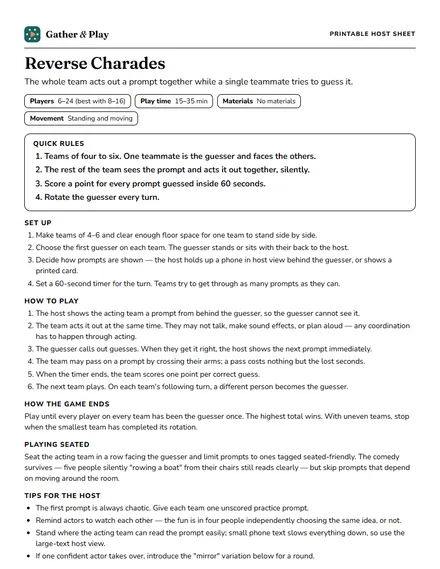
Reverse Charades — Printable host sheet
One page with the quick rules, set-up, and starter prompts — the same content as this page, laid out for print.
Where this game fits
We recommend Reverse Charades in these collections:
- Indoor Party Games for Adults: 9 Picks for Any Living Room
- Family Reunion Games: 10 Ideas That Work for Every Generation
- Birthday Party Games for Adults: 9 Ideas Guests Actually Join In
- Indoor Games for Large Groups: 8 That Still Work With 30 People
- Halloween Party Games for Adults: 8 Friendly-Spooky Ideas
- Christmas Party Games for Adults: 8 Festive Ideas for Mixed Company
About this game
A widely played variation on traditional charades; this explanation, the example and all prompts are original to Gather & Play.
Editorially checked for clarity and consistency. We do not claim group playtesting for this page. Editorial policy.