How to Play Charades
Act out a word or phrase without speaking so your team can guess it before the timer runs out.
- 4–20 players
- 20–45 min
- No materials
- High energy
Quick rules
- Split into two or more teams.
- One player acts out a secret prompt with no words, sounds or mouthing.
- Their team guesses before a 60–90 second timer ends.
- One point per correct guess; teams alternate until everyone has acted.
At a glance
- Players
- 4–20 players
- Best with
- 6–12
- Play time
- 20–45 min
- Prep
- 3 min prep
- Materials
- No materials
- Energy
- High energy
- Noise
- Loud
- Movement
- Standing and moving
- Seated option
- Seated variation
- Where
- Living room, Large room, Outdoors
Times are editorial estimates, not test results.
Reading: The actor reads one short prompt silently, or a teammate from the other side whispers it.
Set up
What you need
Nothing. Voices only.
Nice to have:
- A phone timer
- Printed charades cards from the prompt pack
- Clear a small "stage" where everyone can see the actor. Move drinks and anything breakable out of arm's reach.
- Split into teams of 3–6. Mixed ages and mixed confidence levels on each team keep the game fair.
- Agree on the prompt source — the host view on a phone, printed cards face down, or the opposing team whispering a prompt to the actor.
- Agree on the round length. Ninety seconds is forgiving for new players; sixty seconds suits groups that play often.
How to play
- The first team sends one actor to the stage. The actor looks at a prompt without showing anyone.
- Start the timer. The actor may use gestures, facial expressions and movement only — no speaking, no sound effects, no mouthing words, and no pointing at objects in the room that are the answer.
- Teammates call out guesses freely. The actor may nod, shake their head, or signal "keep going" to steer them.
- If the team says the exact prompt, or a version everyone agrees is close enough, they score one point and the turn ends.
- If the timer ends first, no point is scored. Reveal the answer so the room can enjoy it.
- The actor may pass once per turn and take a new prompt, but the clock keeps running.
- Teams alternate. Every player should act once before anyone acts twice.
Example round
Team Kettle sends Priya up. Her prompt is "untangling headphones". She holds her hands apart as if holding a knotted cord and tugs at it with growing irritation. "Knitting!" — head shake. "Fishing line?" — she waggles her hand for "close", then mimes pushing something into each ear and nodding along to music. "Headphones!" She pulls her hands apart sharply, back to the knot. "Tangled headphones... untangling headphones!" Priya points at the guesser and takes a bow with twenty seconds left. One point to Team Kettle, and Team Ladle sends up their first actor.
How the game ends
Play until every player has acted the same number of times — usually two full rotations — then the team with more points wins. If the evening is running long, announce a "final round" before the last rotation starts rather than stopping mid-way.
Group size: minimum, maximum and how to split
Charades needs at least 4 players and works for up to about 20. It is at its best with 6–12 players.
Above 12 players, keep two teams only if everyone is happy to watch more than act; otherwise split into three or four teams of 4–6 and rotate which team is acting. Above 20, run two separate games in different corners of the room so nobody waits ten minutes for a turn.
Playing seated. Play "tabletop charades": the actor stays seated and uses only hands, face and upper body. Choose prompts tagged as seated-friendly in the charades pack, and drop anything that needs walking, jumping or lying down.
Tips for the host
- Let reluctant actors pair up for their first turn. Two people acting one prompt together is still charades.
- Decide before starting how strict "close enough" is, and let the non-acting team be the judge.
- Keep a visible score only if the group enjoys competing. Many groups play happily with no score at all.
- For mixed ages, give younger or first-time actors the easy-tagged prompts and keep the hard ones for volunteers.
Variations
Category rounds
Announce the category before each turn — animals, occupations, household objects. Knowing the category makes guessing faster and is the kindest way to introduce the game to people who have never played.
Relay charades
Give each team the same list of five prompts. One actor at a time runs to the host, collects the next prompt, and acts it for their own team. The first team to finish all five wins. Use two rooms or opposite ends of a big room so teams cannot overhear each other.
Prompts for this game
180 original charades prompts in six categories, tagged by difficulty and by whether they can be acted from a chair.
Everyday actions
- brushing your teeth
- tying a shoelace
- untangling headphones
- threading a needle
- folding a fitted sheet
- peeling an orange
Printable host sheet
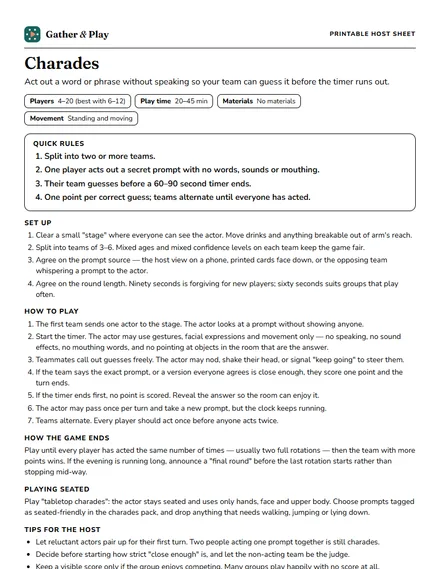
Charades — Printable host sheet
One page with the quick rules, set-up, and starter prompts — the same content as this page, laid out for print.
Where this game fits
We recommend Charades in these collections:
- Indoor Party Games for Adults: 9 Picks for Any Living Room
- Family Reunion Games: 10 Ideas That Work for Every Generation
- Birthday Party Games for Adults: 9 Ideas Guests Actually Join In
- Indoor Games for Large Groups: 8 That Still Work With 30 People
- Halloween Party Games for Adults: 8 Friendly-Spooky Ideas
- Christmas Party Games for Adults: 8 Festive Ideas for Mixed Company
About this game
Traditional parlor game with no single author; this explanation, the example and all prompts are original to Gather & Play.
Editorially checked for clarity and consistency. We do not claim group playtesting for this page. Editorial policy.