How to Play Team Object Pitch
As a team, take an ordinary object from the room and pitch it to the party as a brilliant new invention with a completely different purpose.
- 4–30 players
- 20–40 min
- No materials
- High energy
Quick rules
- Teams of three or four each choose an everyday object from the room.
- The host reads a brief — "pitch it as a travel gadget".
- Teams get three minutes to invent a new use, a name and a slogan.
- Each team pitches for one minute. Everyone votes, but not for their own team.
At a glance
- Players
- 4–30 players
- Best with
- 8–20
- Play time
- 20–40 min
- Prep
- 2 min prep
- Materials
- No materials
- Energy
- High energy
- Noise
- Loud
- Movement
- Standing optional
- Seated option
- Seated variation
- Where
- Living room, Large room, Outdoors, Dinner table
Times are editorial estimates, not test results.
Reading: None. The host reads the pitch brief aloud.
Set up
What you need
Nothing. Voices only.
Nice to have:
- A phone timer
- Pitch briefs from the host view
- Form teams of three or four. Mixing ages and friendship groups makes for better pitches.
- Each team picks one ordinary, unbreakable object from the room — a cushion, a wooden spoon, a slipper, a colander.
- The host reads the pitch brief aloud. All teams work to the same brief.
- Set a three-minute timer for preparation.
How to play
- During preparation, each team invents a new purpose for its object that fits the brief. The object's real purpose may not be used.
- The team gives the product a name and a one-line slogan, and decides who says what. Everyone on the team must speak at least once.
- When preparation ends, teams pitch in turn. Each pitch lasts up to one minute.
- A pitch must include the product's name, what it does, who it is for, and a demonstration using the real object.
- After each pitch, the audience may ask one question, which the team must answer in character.
- When all teams have pitched, everyone votes at the same time by pointing at their favourite. Nobody may vote for their own team.
- The team with the most votes wins the round. For a second round, teams swap objects and get a new brief.
Example round
The brief is "a product for the daily commute". Team one has a colander. After three minutes of frantic whispering, Nadia steps forward. "Commuters! Is your train too loud? Too bright? Too full of other people?" Her teammate Finn puts the colander on his head. "Introducing the Colan-Quiet — the breathable personal privacy dome." A third teammate demonstrates the "handle system" for hanging it on a bag. Slogan — "See nothing. Hear a bit less." The audience asks whether it is waterproof. "It is the opposite of waterproof," says Finn, "and that is a feature." They lose by one vote to a slipper marketed as a phone holster.
How the game ends
One round — a pitch from every team, then the vote — is a complete game. Two rounds with swapped objects is the most that most parties want. Announce the winning team and ask them to repeat their slogan, which gives the game a clean ending.
Group size: minimum, maximum and how to split
Team Object Pitch needs at least 4 players and works for up to about 30. It is at its best with 8–20 players.
Teams of three or four are ideal. Up to twenty players — five or six teams — every team can pitch to the whole room. Between twenty and thirty, limit pitches to forty-five seconds, or run two "heats" in different parts of the room and send the winner of each to a final. Larger than that, the audience's patience runs out before the pitches do.
Playing seated. Teams can plan and pitch from their seats, using an object that is already within reach on the table. Standing to present is optional — a seated pitch delivered with a straight face is often funnier.
Tips for the host
- Approve each team's object before they start. Nothing fragile, valuable, sharp, or belonging to a guest who has not agreed.
- The three-minute limit matters. More time makes teams over-plan and makes the pitches less funny.
- Insist cheerfully on "everyone speaks at least once". It stops one confident person from doing it all.
- For a quieter group, drop the question from the audience and go straight from one pitch to the next.
Variations
Same object, different pitch
Every team pitches the same object — one wooden spoon, passed round the room. Without the luck of the object, the comparison is purely between ideas, and the pitches build on each other's jokes.
Investor panel
Instead of a room vote, three guests sit as a mock panel. Each panel member may "invest" in only one product and must explain why. It suits birthdays — put the guest of honour on the panel.
Prompts for this game
Briefs every team can work to with whatever object they have chosen.
Pitch briefs
- Pitch it as a product for the daily commute.
- Pitch it as essential camping equipment.
- Pitch it as a breakthrough in home fitness.
- Pitch it as a luxury gift.
- Pitch it as a tool for getting to sleep.
- Pitch it as a travel gadget.
- Pitch it as something every new parent needs.
- Pitch it as a gardening innovation.
- Pitch it as office equipment.
- Pitch it as a musical instrument for beginners.
- Pitch it as safety equipment.
- Pitch it as a way to make friends.
- Pitch it as a kitchen time-saver.
- Pitch it as the future of public transport.
Printable host sheet
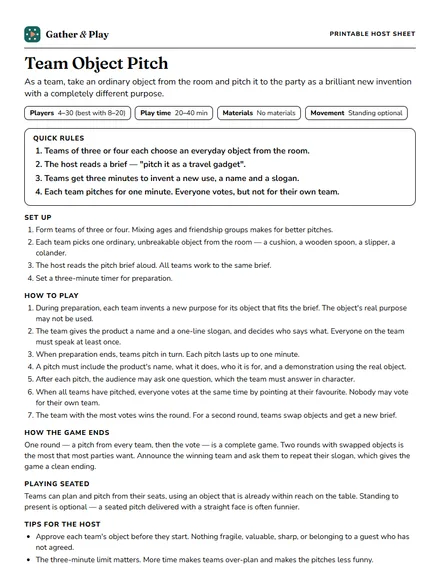
Team Object Pitch — Printable host sheet
One page with the quick rules, set-up, and starter prompts — the same content as this page, laid out for print.
Where this game fits
We recommend Team Object Pitch in these collections:
- Indoor Party Games for Adults: 9 Picks for Any Living Room
- Family Reunion Games: 10 Ideas That Work for Every Generation
- Birthday Party Games for Adults: 9 Ideas Guests Actually Join In
- Indoor Games for Large Groups: 8 That Still Work With 30 People
- Halloween Party Games for Adults: 8 Friendly-Spooky Ideas
- Christmas Party Games for Adults: 8 Festive Ideas for Mixed Company
About this game
An original Gather & Play arrangement of a familiar improvised sales-pitch exercise; all briefs are original.
Editorially checked for clarity and consistency. We do not claim group playtesting for this page. Editorial policy.