Party Games for Seniors: 10 Seated, Sociable Games for Older Adults
Games for adults in their sixties, seventies, eighties and beyond — chosen because they are good games, played seated, at a sociable pace. Nothing here is simplified, and nothing is described as therapy.
The short answer
The best party games for seniors are seated, spoken and unhurried, and they treat players as the experienced adults they are. Two Truths and a Lie, Twenty Questions, Conversation Ladder, Odd One Out and Categories need no equipment or reading, and reward a lifetime of stories and knowledge.
The games we recommend
Share three statements about yourself — two true, one invented — and see whether the group can spot the lie.
Why it fits: A long life provides the best material. Older players' true stories are routinely the hardest to believe.
- 3–12 players
- 10–30 min
- No materials
- Seated
- Works seated
Work out a secret person, place or thing by asking no more than twenty yes-or-no questions.
Why it fits: A classic that many older adults already know, played entirely by voice at whatever pace the group likes.
- 2–10 players
- 10–25 min
- No materials
- Seated
- Works seated
Climb a three-step ladder of questions on one theme — from an easy opener to a more thoughtful one — so that a table of guests ends up in a real conversation.
Why it fits: It invites real stories — about meals, homes, work and journeys — and anyone may pass on any question.
- 3–10 players
- 15–30 min
- No materials
- Seated
- Works seated
Hear four things, decide which one does not belong, and convince the table that your reason is the best one.
Why it fits: There is no single right answer, so nobody can be "wrong". It rewards reasoning and wit over speed.
- 3–12 players
- 10–25 min
- No materials
- Seated
- Works seated
Choose between two alternatives, defend your choice, and find out who at the table thinks the way you do.
Why it fits: Preferences need no memory and no preparation, and every answer starts a conversation.
- 2–30 players
- 10–30 min
- No materials
- Seated
- Works seated
Take turns naming things that fit a category, without repeating an answer or hesitating too long.
Why it fits: Without the pause limit it becomes a relaxed, cooperative list-making game that draws on broad knowledge.
- 3–12 players
- 10–25 min
- No materials
- Seated
- Works seated
Keep a chain of connected words moving round the circle — say the first word the last one brings to mind, and be ready to explain the link.
Why it fits: Played without the speed rule, it is a gentle, often funny chain of connections.
- 3–12 players
- 5–20 min
- No materials
- Seated
- Works seated
Describe a simple picture using words alone so that a partner, who cannot see it, can draw it as accurately as possible.
Why it fits: A calm paired game. Anyone who would rather not draw can be the describer in both rounds.
- 2–16 players
- 10–25 min
- Paper and pen
- Seated
- Works seated
Help your team guess a secret word by giving clues that are exactly two words long — no more, no fewer.
Why it fits: A seated team game with real competitive bite for groups that enjoy crosswords and word puzzles.
- 4–16 players
- 15–30 min
- No materials
- Seated
- Works seated
Build one story as a group, a sentence at a time, with every sentence accepting what came before and adding something new.
Why it fits: Cooperative storytelling with no scoring, in which each person adds a single sentence.
- 3–10 players
- 10–20 min
- No materials
- Seated
- Works seated
Compare the games at a glance
| Game | Players | Play time | Prep | Materials | Movement | Seated option | Energy |
|---|---|---|---|---|---|---|---|
| Two Truths and a Lie | 3–12 | 10–30 min | No prep | No materials | Seated | Yes | Calm |
| Twenty Questions | 2–10 | 10–25 min | No prep | No materials | Seated | Yes | Calm |
| Conversation Ladder | 3–10 | 15–30 min | No prep | No materials | Seated | Yes | Calm |
| Odd One Out | 3–12 | 10–25 min | No prep | No materials | Seated | Yes | Calm |
| Would You Rather | 2–30 | 10–30 min | No prep | No materials | Seated | Yes | Calm |
| Categories | 3–12 | 10–25 min | No prep | No materials | Seated | Yes | Lively |
| Word Association | 3–12 | 5–20 min | No prep | No materials | Seated | Yes | Lively |
| Describe and Draw | 2–16 | 10–25 min | 5 min prep | Paper and pen | Seated | Yes | Calm |
| Two-Word Clues | 4–16 | 15–30 min | 2 min prep | No materials | Seated | Yes | Lively |
| Yes-And Story | 3–10 | 10–20 min | No prep | No materials | Seated | Yes | Calm |
Times are editorial estimates, not test results.
A sociable hour, entirely seated
For six to twelve older adults round a table or in a circle of chairs — a club afternoon, a family visit or a neighbours' get-together.
- Step 1 · 10 minutes
Would You Rather
Read each question twice. Everyone shows a choice; volunteers explain.
- Step 2 · 20 minutes
Two Truths and a Lie
Give a few minutes' thinking time first. Stories afterwards are the best part.
- Step 3 · 15 minutes
Odd One Out
Six sets, read slowly. No timer.
- Step 4 · 15 minutes
Conversation Ladder
One ladder — 'Journeys' or 'Celebrations' — to finish.
About 60 minutes in total. Times are editorial estimates, not test results.
How we chose these games
“Games for seniors” is too often a polite way of saying “games made easier”. We do not think that is what most people are searching for, and it is not what this page offers. Older adults are simply adults, with more experience, and usually more patience for a good conversation. The games here were chosen on five practical grounds:
- Fully seated. Every game is played from a chair from start to finish. There is no hidden step in which someone has to stand, walk, bend or reach.
- Spoken, not written. Players do not need to read small cards or write quickly. One host reads aloud. The only game involving a pen, Describe and Draw, lets anyone choose the speaking role.
- No time pressure by default. Timers are optional everywhere. Where a game normally has a “five-second rule”, we recommend dropping it.
- No dependence on recent pop culture. Nothing requires knowing this year’s films, songs or slang.
- Real substance. These are games people of any age enjoy. We include Two-Word Clues specifically because many older players want a proper challenge.
A note on what this page does not say: we make no claims that games treat, prevent or improve any health condition, memory or mood. We are editors, not clinicians. These are simply sociable activities that are comfortable to play.
Making games comfortable, practically
The adjustments that make the biggest difference are small and apply to any group — they just matter a little more here.
Hearing. Seat people in a circle or round one table so that everyone can see every face; much of “hearing” is lip-reading and expression. Turn off background music. Ask the reader to face the group and repeat each prompt twice — it is in our rules for Would You Rather and Odd One Out already.
Sight. If you hand anything out, print it large. Every printable on this site has a large-print option, and our guide to printing game cards explains how to scale cards up cleanly. Good lighting on the table matters more than font size.
Pace. Remove timers. Allow a minute of thinking before a game that needs ideas, such as Two Truths and a Lie. Go round the circle in order, so that nobody has to fight for a turn.
Stamina. An hour of play, with a break for tea in the middle, is plenty. Four short games are better than one long one.
Choice. Offer every game as an invitation. Some people would rather listen than take a turn, and listening is taking part.
Games grouped by what your group enjoys
| If your group likes… | Play | Why |
|---|---|---|
| Telling stories | Two Truths and a Lie, Conversation Ladder | Both draw on life experience |
| Crosswords and quizzes | Two-Word Clues, Twenty Questions | Wordplay and deduction with a real challenge |
| A good argument | Odd One Out, Would You Rather | No right answers, plenty of opinions |
| Something gentle and funny | Word Association, Yes-And Story | Cooperative, with no score |
| Making things | Describe and Draw | Hands-on, in pairs |
Playing across generations
Many searches for “party games for seniors” come from someone planning a family occasion — a milestone birthday, an anniversary, a holiday meal — where older relatives are guests of honour among younger ones. In that setting:
- Put generations on the same team. Mixed teams prevent the game becoming “the young ones” against “the old ones”, and they are fairer.
- Choose games where experience wins. In Twenty Questions and Categories, breadth of knowledge beats speed.
- Ask for the stories. The multigenerational group of our icebreaker questions includes prompts such as “What is something that was better in the past, and something that is better now?” They work wonderfully between courses.
- Do not assign roles by age. Let anyone act, keep score or watch.
Our family reunion games collection and the guide to adapting games for mixed ages both go further into this.
Common mistakes
- Choosing childish games. Adults notice, and mind. Pick games you would enjoy yourself.
- Shouting. Clear, slightly slower speech while facing the group works better than volume.
- Rushing. A pause is not a problem that needs solving.
- Insisting everyone joins in. Invite; never press.
- Small print. If it must be read, print it large or read it aloud.
Quick answers
What are good party games for seniors?
Two Truths and a Lie, Twenty Questions, Conversation Ladder, Odd One Out, Would You Rather, Categories and Two-Word Clues are all well suited to older adults. Each is played seated and by voice, needs little or no equipment, and has no time limit unless the group wants one.
What games can seniors play sitting down?
Every game on this page is played entirely seated: conversation games such as Would You Rather and Conversation Ladder, deduction games such as Twenty Questions, word games such as Categories, and the paired drawing game Describe and Draw. None includes a step that needs standing.
What are fun group activities for older adults with no equipment?
Spoken games need nothing at all. Try Two Truths and a Lie, Odd One Out, Word Association and Yes-And Story, with a host reading prompts aloud. Our party games without props collection lists twelve voice-only games.
How long should a games session for older adults last?
About an hour including a break is comfortable for most groups: four games of ten to twenty minutes each. Watch the room more than the clock, and finish while people are still enjoying themselves.
Prompts and printables for this occasion
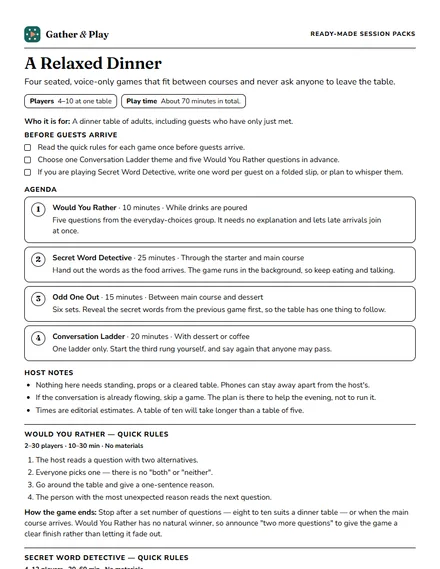
A Relaxed Dinner
Four seated, voice-only games that fit between courses and never ask anyone to leave the table.